In this women’s lives, women’s voices feature, the Women’s Collective Ireland- Donegal team share with you our recent research findings on the community needs of women in the Donegal.WCI-Donegal Team; Rhona Hannigan Development Worker, Sinead Doherty Project Worker and Danielle Bonner Project Coordinator.Photos by Tori Tinney
It’s been a busy year for the Women’s Collective Ireland- Donegal team, in between our planning and the delivery of a range of courses, workshops and events, this year we have also been researching the community needs of women in Donegal. This research began in December 2024, when we launched a women’s needs assessment survey which provided an opportunity for women living in Donegal to express their community needs and share life experiences.
572 women aged 18 and above took part in the assessment which was carried out through an online survey. The findings from this survey now provides us with important insight into the lives of women living in Donegal and highlights the diverse needs of women in rural Ireland.
Women living across the county took the time to share with WCI-Donegal their experiences with mental health, access to local support services, their views on what’s missing for women in the county and their experiences of gender inequality. They spoke openly about mental health, pressure at home and work, lack of affordable childcare, and gaps in community opportunities for women in the county. More than half (52%) said they experience anxiety. Many also reported loneliness, low mood and feeling overwhelmed, especially those in their 30s and 40s, many of whom are juggling work and caring responsibilities.
A common theme among the respondents was the need for a welcoming, women-only space in their community where they could drop in for a chat, a class or a cuppa, somewhere safe, informal and friendly to connect, learn or simply take a break. Others expressed a need for better access to local workshops, creative programmes, and everyday practical support.
While most respondents didn’t know of a Women’s Group in their area, nearly three-quarters said they’d like to join one. Many women also said that gender inequality continues to impact their lives, from taking on more caring responsibilities at home while also working, to facing discrimination at work and feeling unsafe in public spaces.
Women’s Collective Donegal project coordinator Danielle Bonner spoke with Ocean FM about the importance of creating spaces for women, the work WCI-Donegal is planning in response to needs assessment findings and the importance of programme funding to support the community needs of women in Donegal.
Women’s responses also suggest that there are gaps in current community engagement and highlight there is a need to utilise and better connect women to the opportunities that already exist in the community.
Women’s Collective Donegal project coordinator Danielle Bonner highlights what we can do to address these challenges with Highland Radio
Speaking with Greg Hughes on the Nine til Noon Show on Highland Radio about the survey findings
The survey findings will help shape WCI-Donegal’s work, ensuring that our work is grounded in the lived realities of women in Donegal. While the experiences and information shared by women in the survey provides local community organisations and decision-making bodies valuable insight and data to help inform their work allowing us all to better support women to engage and participate in the community, support their wellbeing and empowerment.
Women’s Collective Ireland-Donegal would like to thank and acknowledge all the women who took the time to complete our women’s needs assessment. Their time and insightful input are very much appreciated.
You can read a full copy of the needs assessment report by downloading it here.
WCI-Donegal are always looking for women to share their stories and looking for women to write features on topics of their choice which we will profile as part of our Women’s Lives, Women’s Voices’ series.
Women from across Donegal and representing various community groups attending the Donegal County Council’s EMPOWER HER event in Lifford Council Chamber.
This Women’s Lives, Women’s Voice’s feature is written by Rhona Hannigan, Development Worker with the Women’s Collective Ireland-Donegal. Highlighting the issue of the lack of women in local politics and poses the question, why is there still so many male politicians representing women’s voices in all aspects of Irish politics?
With the local and European elections wrapped up its important that we highlight the continued lack of female political representation in Irish Politics. Why should we focus on women’s politics now as the elections are over, well we have a general election coming up before March next year, with the possibility of an early election in autumn. With so many other focus areas like healthcare, migration and housing, gender equality seems to have gone by the way side. Important issues like pay parity, gender based violence and equal pensions for women. Recent research shows that women in Ireland would need to work eight years longer to retire with the same pensions as men. The 2024 Gender Pension Gap Report from Irish Life found that there is a 36% gender pension gap faced by working women, highlighting the inequalities between men and women right the way through to retirement.
A Global Context
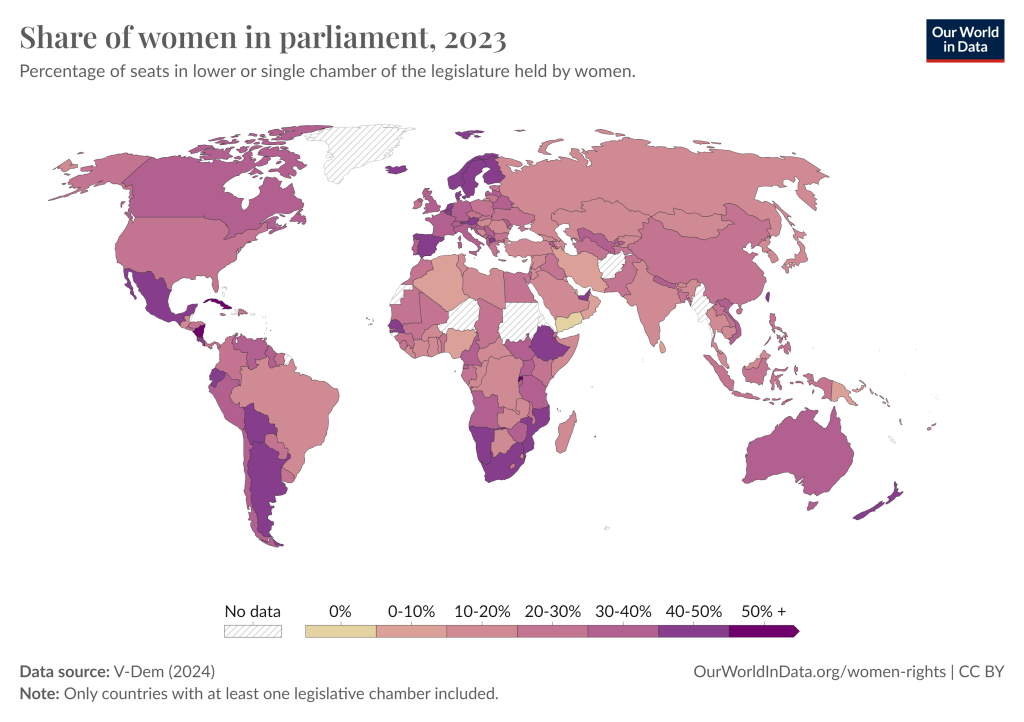
So why is it that not enough women run for office or get elected in Ireland? If we look at the statistics in Europe, Ireland has the 6th lowest rate of female participation in lower houses of parliament, only 26.5% of parliamentarians in single or lower houses are women globally, this has risen from 11% in 1995. There has been a steady rise globally of women in politics visible from the 18th and 19th centuries where women did not have the right to vote or sit in parliaments. According to the United Nations only six countries have 50% or more women in parliament globally, Rwanda have 61%, Cuba have 53%, Nicaragua have 52%, Mexico have 50%, New Zealand have 50% and the United Arab Emirates have 50%. In 2008, Rwanda became the first parliament to have more than 50% women, the first women-majority parliament. The UN also recorded last month that there was 28 countries that had women serve as Heads of State and/or Government. At the current rate it will take 130 years to reach gender equality in the highest positions of power.
In Ireland
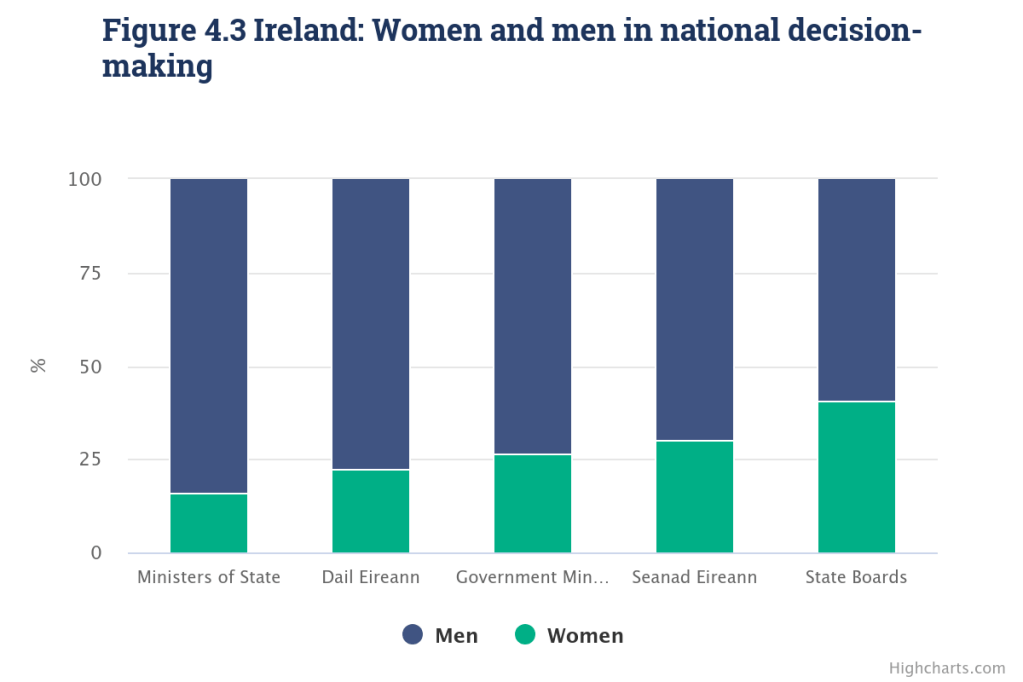
In Ireland, 21.1% of TD’s are women, 38.3% Senators and 25.9% are County Councillors. Barriers exist for women, the “5 Cs”, confidence, childcare, culture, cash and candidate selection are some of the obstacles faced. I recently spoke with a female councillor who sat in a very “traditional Borough” in the North of Ireland. She only ran once as she found it difficult being in a minority, especially when gender sensitive topics arose, she found it “unbearable”. In many cases in our patriarchal system women are still expected to be the main care giver in the home, this limits availability and commitment. We are also resistant to change, traditionally politics has been male dominated and people are reluctant to nominate or vote for someone different. However, voter loyalties to political parties is in decline, elections have become unpredictable. Anti establishment sentiment and positions are contributing to the changing shape of the party system. I believe this will cause more barriers to leveling up women in politics.
Moving Forward
We need to change the dynamic of the political system in Ireland, a change that is reflective of an ever evolving society. Implemented by and includes more women, we need more working-class women, migrant women, Traveler women, rural women, disabled women, more women from the LGBTQI community. Only then will all women be represented here. A 50/50 gender balance in government is key to Ireland becoming a thriving and vibrant society. This quota needs to be met and surpassed. Imagine having a women’s perspective on housing, healthcare or the justice system. How much fairer and more efficient it could be.
There has been a push by various organisations to get more women elected, however, as mentioned by Rachel Coyle, Head of Campaigns and Mobilisation for the National Women’s Council, more women ran in local elections that saw women from diverse backgrounds being elected. However, it still remains that women will only make up around 26 % of Councillors which is the same percentage of outgoing women Councillors.
While a record number of 677 women contested the elections, up from 566 in 2019, it was only 31% of overall candidates. There was an increase in migrant women contesting the elections, however, no Traveller women sought election and in two constituencies, Moate in County Westmeath and An Daingean in County Kerry, no women ran. Local elections are a clear route to national government and both of the two main parties Fianna Fail and Fine Gael failed to meet the 40% quota, failing to even reach 30%. The latest data available in the infographic below compiled by the Central Statistic Office paints a grim picture of women in decision making roles.
In Donegal with thirty-seven seats to fill there was a record nighty one candidates that contested the local elections. Of those elected just three were women from seven electoral areas, one down from the 2019 elections. Joy Beard who ran for the first time was elected on the first count in Buncrana, and Dakota Nic Mheanman was elected in the Lifford-Stranorlar local electoral area. Both Beard and Nic Mheanman are affiliated with the 100% Redress party and Sinn Féin respectively. While Niamh Kennedy retained her seat as an independent candidate in Donegal.
So why is it so important that we encourage more women into politics? Public representation should be diverse, representative of the society we live in. This will benefit all of society promoting a rounded and balanced decision-making process. County Councils implement procedures and make decisions that affect the places where we live, work, and relax whether its affordable housing, road works, environmental issues, providing playgrounds or leisure facilities. Governments make decisions that affect us at a global level. Decisions made by elected representatives affect our everyday life, so it is crucial that women play an equal part in that decision-making process.
Upcoming Women in Local Leadership (WILL) programmein Donegal
Let’s celebrate and support women in leadership together! Join the new Women’s Collective Ireland-Donegal programme starting on Tuesday 17th September 10am-1pm in Donegal Town. This is a FREE 8-week programme for women and a space for you to explore what leadership means and develop your skills and confidence. Over the sessions you will learn about local government structures and voting with a field trip to local government in Lifford and with the opinion to visit Dáil Éireann, look at equality and human rights issues, think critically about lived experiences, gender equality and issues that hold back women’s equality and participation in society. Exploring ways to empower and support those affected by gender discrimination.
If you would like to take part in this programme please fill in our form here https://forms.gle/fUvymoZNasTv8T8n8 and we will be in contact. For more information please email WCI-Donegal on donegal@womenscollective.ie or text us on 085 8638419.
WCI-Donegal are always looking for women to share their stories and looking for women to write features on topics of their choice which we will profile as part of our Women’s Lives, Women’s Voices’ series.
Catherine Culbert HCPC Registered Dietitian, Personal Trainer and Yoga Teacher specialising in sports nutrition and women’s health.
This Women’s Collective Ireland- Donegal, ‘Women’s Lives, Women’s Voices’ feature is written by Rhona Hannigan, Development Worker with the Women’s Collective in Donegal Town and Catherine Culbert HCPC Registered Dietitian who specialises in sports nutrition and women’s health. Highlighting the importance of education on the impact of the menstrual cycle and women in sport.
As many people know I love football and in particular women’s football. Women’s football has come on leaps and bounds but a huge disparity still remains between the men’s and women’s game especially in terms of wages, attendance at matches and funding available to improve structures within women’s football. We often hear the old argument that ” men’s games generate more revenue” and that is partly why men are paid more. However, if the same amount of time and effort had gone into women’s football in the past who knows where we would be today.
Girl’s football is the fastest-growing sport in the country. There are chances for girls to play that have never been available before. It’s only 15 years ago that Stephanie Roche was playing with her local boy’s team because there wasn’t any options for her. Now, there are options at every level from community to elite. The success of the Irish women’s football team in recent years has had a profound effect on the Irish public and especially on many young girls who want to emulate players like Katie McCabe and Denise O’Sullivan. Attendance at women’s football matches is breaking records. Women’s football in Ireland is on a journey with many positive steps implemented already. We have prominent companies like Sky who sponsor the women’s national team, who’s advertising can be seen nationwide, and Cadbury Ireland who have given tremendous support to the growth of women’s grassroots football and have recently launched their ‘The Game is On’ campaign that aims to drive more interest in local clubs, game attendance, volunteering and supporting the game in general.
Despite the fact that many girls and women love football, it’s still a sport that’s overwhelmingly dominated by men. Even with the increased popularity, women face barriers that prevent them from participating. Such barriers may include feeling self-conscious about body image, social stereotyping and harassment or doubts around skill level or perceived lack of skills “because you are a girl”. Football has a male-dominated sports culture and more often than not your role model will be a male footballer, for me there is only one Roy Keane, the only one person iv ever hero worshipped.
All levels of football coaching is male dominated and more female coaches is preferable to bridge the gap. However, thankfully, despite what sex the coaches are they devote crazy hours of their free time coaching so that we have girls football. That said, coaching girls is very different to boys. I’m involved with Derry City FC Women’s Academy, I’m the Child Welfare Officer and also on the coaching staff of the U17’s and U19’s. Derry has an amazing ethos of education off the pitch as well as on the pitch. Head of the academy, Jarleth Canning, thought it prudent that the teams should have a female on the coaching staff as all our coaches are males. As the Welfare Officer one of the areas I thought important to highlight was how women are affected by their mensural cycle when participating in sport. It was shocking speaking to some of the coaching staff, who had never considered the affect periods had on girls and their performance, so after research and recommendations I asked Catherine Culbert to present to the coaches and players on this topic; here is her story.
Some of the “Derry Girls” at the educational talk about menstruation and women in sport.The presentation was organised by Derry City FC Women’s Academy
The importance of education around the menstrual cycle and women in sport
“Menstrual cycles are a completely natural process for most girls and women, yet they are often the elephant in the room for female athletes. Menstrual cycles can be a huge barrier for girls and women continuing to play sport throughout their lifecycle or reaching their full potential in sport. In a recent survey by Youth Trust Sport periods and low confidence were the most common reasons girls gave for not wanting to take part in PE¹. Its important that girls and women feel supported to continue to play sport for as long as possible and to do this, we need to raise awareness and educate athletes, coaches and parents on menstrual cycles for women in sport.
As a female athlete myself, I started my period when I was 12. At that time, I swam competitively for a local swimming club and often felt embarrassed and worried each time I got my period and had to juggle swimming training and competitions. At that time, most of my coaches growing up were men and so I never dreamt of mentioning it to them. Looking back, I wish I felt more supported that having a menstrual cycle was completely normal and perhaps as a young girl given education on how to manage menstrual health around sport and training. Even the provision of period products in the swimming changing rooms would have been an absolute game-changer to help normalise it and for emergencies.
When it comes to menstrual cycles, there is no ‘normal’, as every woman and girls’ body is different. Not all athletes have a regular cycle, due to hormonal imbalances, contraceptives, pregnancy, or menopause, so there is no ‘one size fits all’ advice.
However, most women and girls at some stages are likely to suffer from menstrual cycle symptoms which can impact on their physical performance in sport. Examples include bloating, digestive issues, mood swings, increased hunger, cravings, acne, low confidence, reduced energy, endurance, and strength. Another thing to consider is that bloating, and water retention can significantly impact on body image, especially for young girls which might affect their confidence in sport around this time.
Raising awareness and speaking about menstrual cycles for girls and women in sport can support the management of symptoms as well as encouraging female athletes to seek help if menstrual cycles are a barrier to them playing sport.
The effect of menstrual cycle on sports performance is now being increasingly recognised. Studies show 50-86% of women reported sport-related menstrual problems or that menstruation has affected their participation in training and competition.
The benefits of increasing awareness and education around menstrual cycle and sport includes:
Girls and women supported to continue to play sport for longer
Female athletes supported to reach their full potential
Reduced risk of injury due to better understanding and management of symptoms
More women and girls participating in sport
More positive attitudes towards sport and exercise from girls and women
Less shame and embarrassment
What can clubs and sports teams do to support girls and women with their menstrual cycle
The first place to start is getting buy-in and commitment from coaches to raise awareness of how menstrual cycles can affect female athletes. This can be done by organising a session where all coaches and athletes attend. Nutrition plays a key role in supporting with symptom management around menstrual cycles so a nutrition session that focuses on food and nutrients to support symptoms can be helpful starting point for coaches and athletes.
Coaches also need to normalise menstrual cycles and periods by speaking about them regularly, encouraging athletes to track and understand how their cycle affects them personally. Teams and clubs can also provide period products in changing rooms and provide emergency products in a kit bag for matches/ competitions away to support athletes.
Providing a safe space for female athletes to speak to coaches about barriers such as periods can really support athletes in staying consistent with training ad matches. Not all athletes will want to discuss their period with coaches, especially younger girls but it’s still important to raise awareness and provide education on this area for all.”
WCI-Donegal are always looking for women to share their stories and looking for women to write features on topics of their choice which we will profile as part of our Women’s Lives, Women’s Voices’ series.
This feature is part of the Women’s Collective Ireland- Donegal, “Women’s Lives, Women’s Voices’ series. Written by Siobhan Cullen LLb Msc Solicitor Mediator. This story recounts Siobhan’s life from childhood, her passion for justice and equality and the journey that led to her being appointed as one of the Equality Commissioners for Northern Ireland.
I have always had a strong interest in equality and anti-discrimination policies, possibly due to my upbringing by Irish emigrant parents in North London. My dad was from Dublin and mum is from Donegal and they moved to London in 1960 where they lived for 40 years before returning to Donegal. We lived in a very diverse and multi-ethnic community on a council estate which was a brilliant experience in terms of developing social skills, resilience and acted as a grounding for my interest in equality.
I recall incidents during the 1970’s and 1980’s involving discriminatory behaviour by the authorities. One thing I recall is the regular police questioning of my next-door neighbours, who were from the West Indies, about their whereabouts when a crime had been committed locally. There was also some anti-Irish sentiment during the 1980’s and I vividly remember anti-Irish graffiti being sprayed locally during the troubles.
I felt very much part of the Irish community in London and social justice was often on my mind so, at the age of 14, I decided that I wanted to become a criminal defence solicitor. As the first person in my family to go to college, I attended Middlesex University in Hendon aged 18. I initially felt slightly challenged and lacking in confidence as a student. I’ve always empathised with students who feel this way as I remember it well, especially on the first day when I was tempted to leave the lecture hall amid many vocal and confident peers. It was the empathy and inclusive attitude of certain lecturers that engaged me, something I later aspired to become in my own teaching career.
I obtained a first-class law degree and qualified as a solicitor three years later, aged 24, specialising in criminal defence and family law. I worked for eight years in a legal aid firm in Tottenham, North London during which time I probably learnt more than during any other time in my life.
This experience shaped me and made me who I am today, without a doubt. It was fulfilling work but also challenging as many clients had suffered trauma and abuse as well as having addiction and mental health issues. I spent much of my time in police stations and court and represented clients in every type of case imaginable, some very traumatic.
I really enjoyed the family law work, representing many women in domestic violence applications and child-care proceedings. I found representing clients in court, especially juvenile cases, so incredibly interesting and fulfilling. It was also challenging as legal aid work was hugely under-funded, something which has unfortunately disimproved even more in recent years. In my view, legal aid is a crucial aspect of access to justice which was my entire purpose back then and this remains so today. I also volunteered for FLAC during this time and set up a legal advice clinic in the local psychiatric hospital.
In 1999 I moved to Ireland, always my “spiritual home”, and undertook a Masters in Equality Studies at UCD and then begun an academic career with Letterkenny Institute of Technology (LYIT) where I remained for twenty-two years. I loved working with students and delivered modules in Family & Child Law, Legal Systems, Restorative Justice, Tort, Law in Action, Mediation and Street Law, the latter of which is my all-time favourite aspect of legal education.
Street Law is a form of public legal education whereby law students are trained to deliver law programmes in schools and community settings, developing their skills through experiential learning but also really enhancing the legal knowledge of the participants. It helps to remove the mystique and elitism often associated with law and build legal literacy skills within communities which really enables people to embrace the law, use it to their advantage and not view it as something to be feared.
I developed the Street Law programme at LYIT with a brilliant colleague who has a similar interest in experiential learning, and we worked with many fantastic students, many of whom I am still in contact with as they embark upon and continue their professional careers. This is one advantage of social media as it makes networking and keeping in touch with alumni so much easier, which is mutually beneficial. I was Head of Department of Law, Public Service and Education for 5 years and then took a career break last year to embrace some new and exciting challenges.
I joined the Open University as a law lecturer, and I cannot speak highly enough of the OU’s policies and practices in relation to accessibility, inclusivity, and student-centred ethos. It really does walk the walk. The flexibility of online distance learning is so appealing, the student body is diverse with many students having full-time jobs and family commitments, caring responsibilities and some residing in secure accommodation. Colleagues are incredibly supportive of each other as well as students and the social justice ethos prevails at every level. The fairness and equality which underpins every aspect of the OU, from student-facing policies to staff policies, is authentic and an exemplar of what EDI means in practice. An example would be that every assessment is reviewed by several critical readers to ensure compliance with policies and accessibility to all students with alternative versions provided for students with additional needs or accessibility issues.
My recent appointment as an Equality Commissioner for Northern Ireland (ECNI) has really been extremely fulfilling. I am privileged to work with such a brilliant organisation, supporting and maintaining equality by monitoring compliance with statutory duties, providing legal assistance in legal actions and raising awareness. The work undertaken by the commission is crucial and some of the recently successful cases are testament to this. This is a particularly challenging time in Northern Ireland with post-Brexit issues and I am honoured to work with fantastic colleagues, both commissioners and the legal officers/ full-time staff to support the community through these challenging times.
I am also a Tribunal member with the Mental Health Commission as I have always had a strong interest in mental health, and I strongly believe that the Tribunals play a vital role in upholding human rights and rights of persons detained.
I have recently been appointed as a Tribunal member with IPAT (International Protection Appeals Tribunal) which hears appeals from applicants seeking refugee status and/or subsidiary protection.
I’m on the Board of Donegal Sports Partnership, an amazing organisation based entirely on the ethos of inclusivity, accessibility with a real focus on sport for those of us with additional needs as well as gender and ethnicity.
I am currently Chair of Donegal Women’s Centre which provides invaluable services to local women, including medical, counselling and programme facilitation. Again, there is a great team delivering these vital services with such commitment and drive which is a common theme in the community/ voluntary sector.
I am also a voluntary panel assessor with Athena Swan Ireland which considers applications from HEI’s for gender equality recognition, a very significant development within the education sector. Gender equality is an issue that is very high on my personal agenda from every perspective, and I am delighted to have been appointed Athena Swan lead at the OU Law School for 2023/24.
I hope my story, including humble beginnings, initial lack of confidence as a law student and the development of my career trajectory will inspire other women to follow their dreams.
If in doubt, I would say to volunteer as this is such a good pathway to experience and demonstrates commitment. I have always done some voluntary work and hopefully this will continue. The common theme in all my current roles is teamwork and commitment which are key to supporting communities and developing change.
There are so many aspects to law, some more lucrative than others, yet I find that the areas I have chosen to work in are the most fulfilling for me personally.
I started working in criminal defence, my dream aged 14, and I am now in a place I have always wanted to be, enhancing equality and human rights with only one goal in mind, improving access to both justice and education for everyone.
WCI-Donegal are always looking for women to share their stories and looking for women to write features on topics of their choice which we will profile as part of our Women’s Lives, Women’s Voices’ series.





 Women's Collective Donegal