Tag Archive | Donegal

Why is Circular Dress Collaborative the Talk of the Town?

Sheila Clancy O’Donnell has always believed in the motto “what comes around, goes around.” This belief resonates deeply with her career and the crossroads she finds herself at today. Since she was five years old, she dreamed of a role with the American womenswear brand Liz Claiborne, a dream that came true when she was plucked from college by this icon. Travelling the world, trend shopping on Fifth Avenue in New York City, and dressing millions of American women for decades was a fortunate adventure. Watching her designs progress from sketches to the sales floor was a thrill that was never undervalued.

However, the life of raising children while jetting around the globe for months didn’t blend well. Leaving behind such a cherished career led to a positive turn when she relocated to picturesque Donegal. It was here that her creativity was reignited, inspired by fresh air, a kind community, and the stunning colours that surround her. With a newfound passion for storytelling and nurturing others, Sheila wrote a children’s book and developed a fashion course at both secondary and third levels, celebrating Donegal’s exquisite fabrics and the circular environment they create. Having collaborated in New York on collections that incorporated Donegal tweed, she felt it essential to keep the fabric’s heritage alive.

It was Sheila’s 19-year tenure as a manager for Marks & Spencer, Homestore and More, and TJX Europe that allowed her space to advocate and deliver on these aspirations. Her dedication to sustainable fashion in schools earned her the title of “Face of Corporate and Social Responsibility.” She was also recognised for notable charitable involvement in “Denim vs. Cancer,” a design event organised with her fashion students, and “Friends of the Elderly,” her cherished workmates.

Inspired to contribute further to a sustainable future, Sheila enrolled in an online Master of Science in Sustainability Leadership at the University of Galway in 2023. A field trip to Bologna, Italy, in 2024 sparked the inspiration for Circular Dress Collaborative. Visiting Eta Beta, a social enterprise aiding marginalised individuals through art and agriculture, Sheila realised she could channel her fashion knowledge into a model that could benefit Letterkenny, Donegal, and the environment. Learning about the climate crisis exacerbated by excessive clothing consumption motivated her to act, creating a project that maximises benefits for the community. The first stop was the Donegal Local Development Company (DLDC) in Letterkenny to understand the steps needed to make this social enterprise thrive.

With that help, the Circular Dress Collaborative was born, embodying the principles of “Resale, Repair, Repurpose, Rebuild, and Remember.” Its clothing collection is carefully curated and sourced from women both locally and beyond, ensuring a diverse range from luxury to high-street. When items are sold, the majority of the proceeds go to the women who originally owned them—this being the “Resale” aspect. “Repairs” extend the life of garments, “Repurpose” encourages creativity through arts and crafts, and “Rebuild” involves training volunteers and social welfare recipients in a supportive business setting. Classes teach new skills, which is the “Remember” aspect of this movement. The mission is to keep clothing and fabrics circulating, ensuring that people and opportunities are also not forgotten.

Sheila’s endeavour to empower women who might otherwise feel marginalised was awarded Best Sustainable Practice at the 2024 DLDC Community Recognition Awards, after only three months of opening.

There’s no denying this is an example of a career coming full circle, reconnecting a designer with her passions for fashion and community. Ironically, just a week ago, a customer brought in a handbag to sell—and it was from… Liz Claiborne! Signs like this make Sheila believe “what comes around is meant to go around again.”

The Circular Dress Collaborative is located at Unit 1 Thorn Road, Letterkenny, F92 X8PP (directly next to the Kube Building)

Opening hours: 10.00am – 5.00pm Wednesday – Saturday & 12.00pm – 5.00pm Sunday

Website & Socials

https://circulardresscollaborative.com/

https://www.facebook.com/circulardresscollaborative

https://www.instagram.com/circulardresscollab/
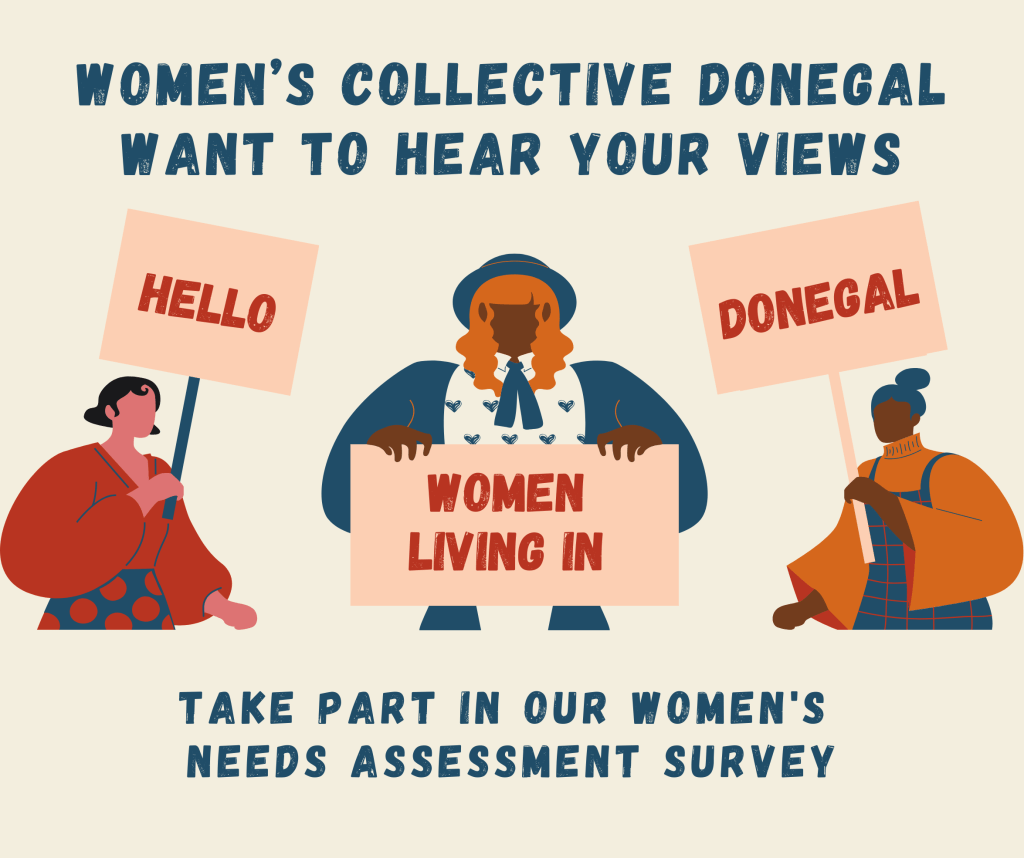
Donegal Women, We Want Your Views

Women’s Collective Ireland – Donegal, is calling on the women of Donegal to share their voices and perspectives by participating in an important survey. This initiative will help shape the programmes, events, and activities offered in 2025 and beyond, ensuring that they align with the real needs and priorities of local women.

For over 20 years, Women’s Collective Ireland – Donegal (formerly NCCWN Donegal Women’s Network) has provided supportive spaces for women to come together for community education, social activities, and advocacy for equality and human rights. As part of the Women’s Collective Ireland network of 17 community projects nationwide, the Donegal branch works tirelessly to bring a gender lens to community and local development initiatives.

The survey is open to all women living in Donegal and covers a range of topics, inviting women to share what’s important to them and what activities they would like to see. The findings will be used to inform our work and highlight key issues affecting women in the county. Additionally, the results will be shared with other local community organisations to help enhance the support available to women across Donegal.

This is your chance to help us better understand the issues impacting women’s lives and how we can address them together. As a thank you, those who complete the survey fully will have the chance to win a €50 One-for-All voucher by providing their contact details at the end of the survey.

The survey will close on Friday 20th December. All survey responses will be stored securely, and participants’ anonymity will be protected in any reports or publications.

Please take a moment to have your voice heard. To access the survey, please click here.

Women’s Collective Ireland is Funded by the Department of Children, Equality, Disability, Integration and Youth. Registered Charities Number: 20060688 Company Number: 400554

Why are women significantly outnumbered by men in Irish politics?


Women from across Donegal and representing various community groups attending the Donegal County Council’s EMPOWER HER event in Lifford Council Chamber.

This Women’s Lives, Women’s Voice’s feature is written by Rhona Hannigan, Development Worker with the Women’s Collective Ireland-Donegal. Highlighting the issue of the lack of women in local politics and poses the question, why is there still so many male politicians representing women’s voices in all aspects of Irish politics?


With the local and European elections wrapped up its important that we highlight the continued lack of female political representation in Irish Politics. Why should we focus on women’s politics now as the elections are over, well we have a general election coming up before March next year, with the possibility of an early election in autumn. With so many other focus areas like healthcare, migration and housing, gender equality seems to have gone by the way side. Important issues like pay parity, gender based violence and equal pensions for women. Recent research shows that women in Ireland would need to work eight years longer to retire with the same pensions as men. The 2024 Gender Pension Gap Report from Irish Life found that there is a 36% gender pension gap faced by working women, highlighting the inequalities between men and women right the way through to retirement.


A Global Context

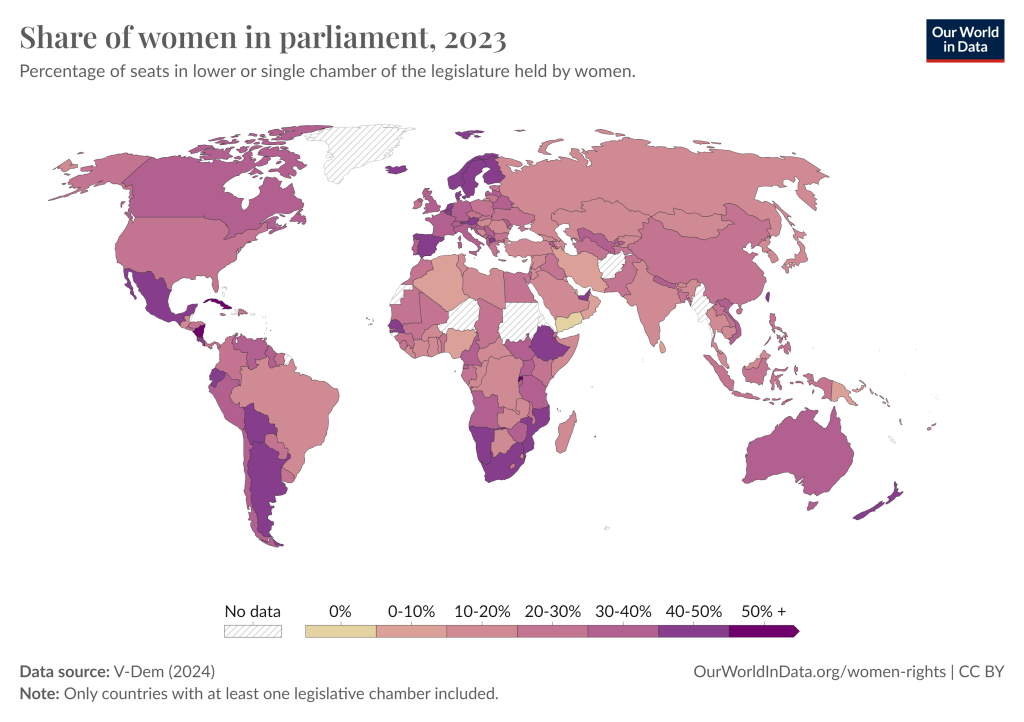
So why is it that not enough women run for office or get elected in Ireland? If we look at the statistics in Europe, Ireland has the 6th lowest rate of female participation in lower houses of parliament, only 26.5% of parliamentarians in single or lower houses are women globally, this has risen from 11% in 1995. There has been a steady rise globally of women in politics visible from the 18th and 19th centuries where women did not have the right to vote or sit in parliaments. According to the United Nations only six countries have 50% or more women in parliament globally, Rwanda have 61%, Cuba have 53%, Nicaragua have 52%, Mexico have 50%, New Zealand have 50% and the United Arab Emirates have 50%.  In 2008, Rwanda became the first parliament to have more than 50% women, the first women-majority parliament. The UN also recorded last month that there was 28 countries that had women serve as Heads of State and/or Government. At the current rate it will take 130 years to reach gender equality in the highest positions of power.


In Ireland

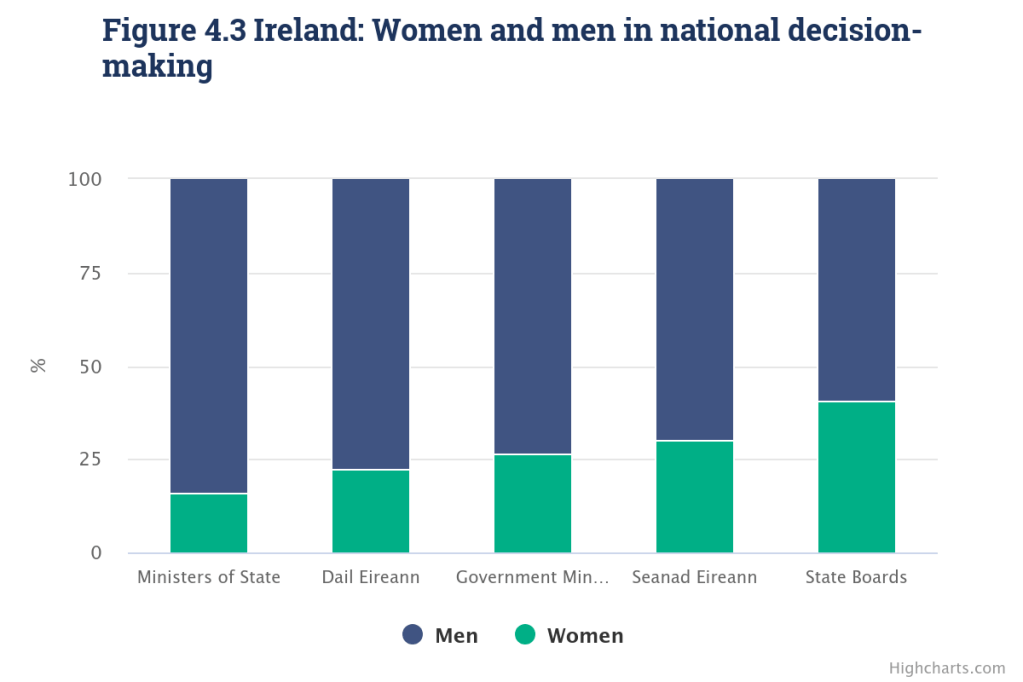
In Ireland, 21.1% of TD’s are women, 38.3% Senators and 25.9% are County Councillors. Barriers exist for women, the “5 Cs”, confidence, childcare, culture, cash and candidate selection are some of the obstacles faced. I recently spoke with a female councillor who sat in a very “traditional Borough” in the North of Ireland. She only ran once as she found it difficult being in a minority, especially when gender sensitive topics arose, she found it “unbearable”. In many cases in our patriarchal system women are still expected to be the main care giver in the home, this limits availability and commitment. We are also resistant to change, traditionally politics has been male dominated and people are reluctant to nominate or vote for someone different. However, voter loyalties to political parties is in decline, elections have become unpredictable. Anti establishment sentiment and positions are contributing to the changing shape of the party system. I believe this will cause more barriers to leveling up women in politics.


Moving Forward

We need to change the dynamic of the political system in Ireland, a change that is reflective of an ever evolving society. Implemented by and includes more women, we need more working-class women, migrant women, Traveler women, rural women, disabled women, more women from the LGBTQI community. Only then will all women be represented here. A 50/50 gender balance in government is key to Ireland becoming a thriving and vibrant society. This quota needs to be met and surpassed. Imagine having a women’s perspective on housing, healthcare or the justice system. How much fairer and more efficient it could be.

There has been a push by various organisations to get more women elected, however, as mentioned by Rachel Coyle, Head of Campaigns and Mobilisation for the National Women’s Council, more women ran in local elections that saw women from diverse backgrounds being elected. However, it still remains that women will only make up around 26 % of Councillors which is the same percentage of outgoing women Councillors.

While a record number of 677 women contested the elections, up from 566 in 2019, it was only 31% of overall candidates. There was an increase in migrant women contesting the elections, however, no Traveller women sought election and in two constituencies, Moate in County Westmeath and An Daingean in County Kerry, no women ran. Local elections are a clear route to national government and both of the two main parties  Fianna Fail and Fine Gael failed to meet the 40% quota, failing to even reach 30%. The latest data available in the infographic below compiled by the Central Statistic Office paints a grim picture of women in decision making roles.


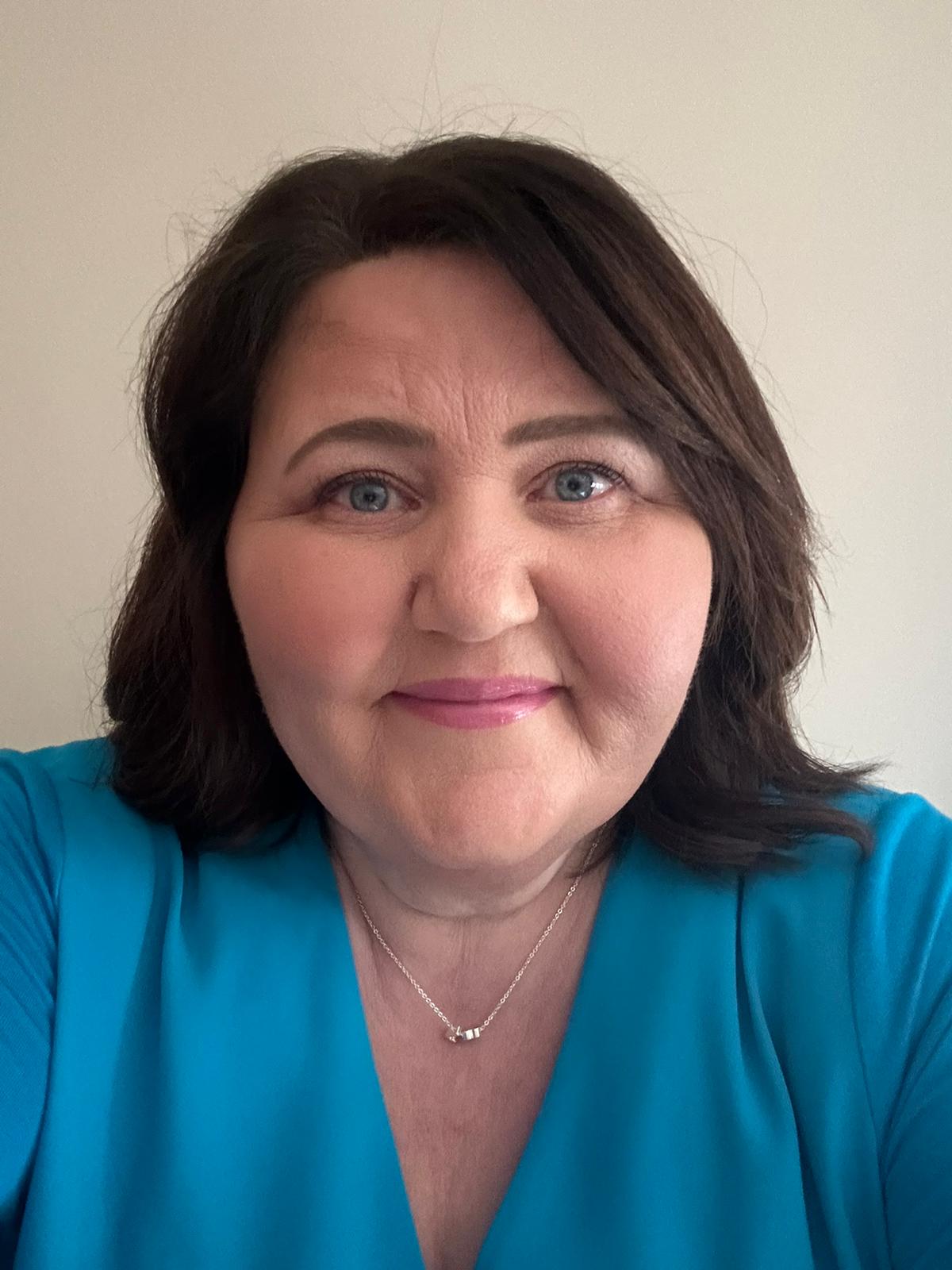
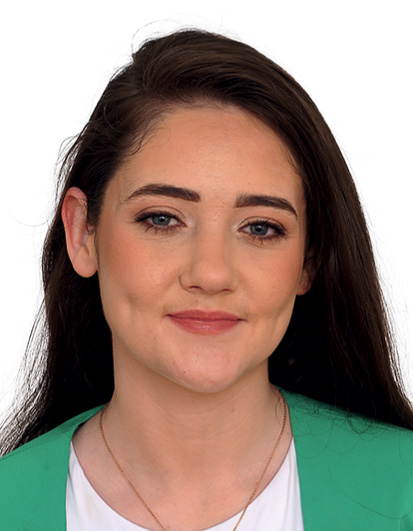
In Donegal with thirty-seven seats to fill there was a record nighty one candidates that contested the local elections. Of those elected just three were women from seven electoral areas, one down from the 2019 elections. Joy Beard who ran for the first time was elected on the first count in Buncrana, and Dakota Nic Mheanman was elected in the Lifford-Stranorlar local electoral area. Both Beard and Nic Mheanman are affiliated with the 100% Redress party and Sinn Féin respectively. While Niamh Kennedy retained her seat as an independent candidate in Donegal. 

So why is it so important that we encourage more women into politics? Public representation should be diverse, representative of the society we live in. This will benefit all of society promoting a rounded and balanced decision-making process. County Councils implement procedures and make decisions that affect the places where we live, work, and relax whether its affordable housing, road works, environmental issues, providing playgrounds or leisure facilities. Governments make decisions that affect us at a global level. Decisions made by elected representatives affect our everyday life, so it is crucial that women play an equal part in that decision-making process.


Upcoming Women in Local Leadership (WILL) programme in Donegal

Let’s celebrate and support women in leadership together! Join the new Women’s Collective Ireland-Donegal programme starting on Tuesday 17th September 10am-1pm in Donegal Town. This is a FREE 8-week programme for women and a space for you to explore what leadership means and develop your skills and confidence. Over the sessions you will learn about local government structures and voting with a field trip to local government in Lifford and with the opinion to visit Dáil Éireann, look at equality and human rights issues, think critically about lived experiences, gender equality and issues that hold back women’s equality and participation in society. Exploring ways to empower and support those affected by gender discrimination.

If you would like to take part in this programme please fill in our form here https://forms.gle/fUvymoZNasTv8T8n8 and we will be in contact. For more information please email WCI-Donegal on donegal@womenscollective.ie or text us on 085 8638419.


WCI-Donegal are always looking for women to share their stories and looking for women to write features on topics of their choice which we will profile as part of our Women’s Lives, Women’s Voices’ series.

Women in Sport: The importance of education around the impact of the menstrual cycle in sport

Catherine Culbert HCPC Registered Dietitian, Personal Trainer and Yoga Teacher specialising in sports nutrition and women’s health.

This Women’s Collective Ireland- Donegal, ‘Women’s Lives, Women’s Voices’ feature is written by Rhona Hannigan, Development Worker with the Women’s Collective in Donegal Town and Catherine Culbert HCPC Registered Dietitian who specialises in sports nutrition and women’s health. Highlighting the importance of education on the impact of the menstrual cycle and women in sport.


As many people know I love football and in particular women’s football. Women’s football has come on leaps and bounds but a huge disparity still remains between the men’s and women’s game especially in terms of wages, attendance at matches and funding available to improve structures within women’s football. We often hear the old argument that ” men’s games generate more revenue” and that is partly why men are paid more. However, if the same amount of time and effort had gone into women’s football in the past who knows where we would be today.

Girl’s football is the fastest-growing sport in the country. There are chances for girls to play that have never been available before. It’s only 15 years ago that Stephanie Roche was playing with her local boy’s team because there wasn’t any options for her. Now, there are options at every level from community to elite. The success of the Irish women’s football team in recent years has had a profound effect on the Irish public and especially on many young girls who want to emulate players like Katie McCabe and Denise O’Sullivan. Attendance at women’s football matches is breaking records. Women’s football in Ireland is on a journey with many positive steps implemented already. We have prominent companies like Sky who sponsor the women’s national team, who’s advertising can be seen nationwide, and Cadbury Ireland who have given tremendous support to the growth of women’s grassroots football and have recently launched their ‘The Game is On’ campaign that aims to drive more interest in local clubs, game attendance, volunteering and supporting the game in general.


Despite the fact that many girls and women love football, it’s still a sport that’s overwhelmingly dominated by men. Even with the increased popularity, women face barriers that prevent them from participating. Such barriers may include feeling self-conscious about body image, social stereotyping and harassment or doubts around skill level or perceived lack of skills “because you are a girl”. Football has a male-dominated sports culture and more often than not your role model will be a male footballer, for me there is only one Roy Keane, the only one person iv ever hero worshipped.

All levels of football coaching is male dominated and more female coaches is preferable to bridge the gap. However, thankfully, despite what sex the coaches are they devote crazy hours of their free time coaching so that we have girls football. That said, coaching girls is very different to boys. I’m involved with Derry City FC Women’s Academy, I’m the Child Welfare Officer and also on the coaching staff of the U17’s and U19’s. Derry has an amazing ethos of education off the pitch as well as on the pitch. Head of the academy, Jarleth Canning, thought it prudent that the teams should have a female on the coaching staff as all our coaches are males. As the Welfare Officer one of the areas I thought important to highlight was how women are affected by their mensural cycle when participating in sport. It was shocking speaking to some of the coaching staff, who had never considered the affect periods had on girls and their performance, so after research and recommendations I asked Catherine Culbert to present to the coaches and players on this topic; here is her story.


Some of the “Derry Girls” at the educational talk about menstruation and women in sport. The presentation was organised by Derry City FC Women’s Academy

The importance of education around the menstrual cycle and women in sport

“Menstrual cycles are a completely natural process for most girls and women, yet they are often the elephant in the room for female athletes. Menstrual cycles can be a huge barrier for girls and women continuing to play sport throughout their lifecycle or reaching their full potential in sport. In a recent survey by Youth Trust Sport periods and low confidence were the most common reasons girls gave for not wanting to take part in PE¹. Its important that girls and women feel supported to continue to play sport for as long as possible and to do this, we need to raise awareness and educate athletes, coaches and parents on menstrual cycles for women in sport. 

As a female athlete myself, I started my period when I was 12. At that time, I swam competitively for a local swimming club and often felt embarrassed and worried each time I got my period and had to juggle swimming training and competitions. At that time, most of my coaches growing up were men and so I never dreamt of mentioning it to them. Looking back, I wish I felt more supported that having a menstrual cycle was completely normal and perhaps as a young girl given education on how to manage menstrual health around sport and training. Even the provision of period products in the swimming changing rooms would have been an absolute game-changer to help normalise it and for emergencies. 

When it comes to menstrual cycles, there is no ‘normal’, as every woman and girls’ body is different. Not all athletes have a regular cycle, due to hormonal imbalances, contraceptives, pregnancy, or menopause, so there is no ‘one size fits all’ advice.


However, most women and girls at some stages are likely to suffer from menstrual cycle symptoms which can impact on their physical performance in sport. Examples include bloating, digestive issues, mood swings, increased hunger, cravings, acne, low confidence, reduced energy, endurance, and strength. Another thing to consider is that bloating, and water retention can significantly impact on body image, especially for young girls which might affect their confidence in sport around this time.

Raising awareness and speaking about menstrual cycles for girls and women in sport can support the management of symptoms as well as encouraging female athletes to seek help if menstrual cycles are a barrier to them playing sport.

The effect of menstrual cycle on sports performance is now being increasingly recognised. Studies show 50-86% of women reported sport-related menstrual problems or that menstruation has affected their participation in training and competition.


The benefits of increasing awareness and education around menstrual cycle and sport includes:

  • Girls and women supported to continue to play sport for longer
  • Female athletes supported to reach their full potential
  • Reduced risk of injury due to better understanding and management of symptoms
  • More women and girls participating in sport
  • More positive attitudes towards sport and exercise from girls and women
  • Less shame and embarrassment

What can clubs and sports teams do to support girls and women with their menstrual cycle

The first place to start is getting buy-in and commitment from coaches to raise awareness of how menstrual cycles can affect female athletes. This can be done by organising a session where all coaches and athletes attend. Nutrition plays a key role in supporting with symptom management around menstrual cycles so a nutrition session that focuses on food and nutrients to support symptoms can be helpful starting point for coaches and athletes.

Coaches also need to normalise menstrual cycles and periods by speaking about them regularly, encouraging athletes to track and understand how their cycle affects them personally. Teams and clubs can also provide period products in changing rooms and provide emergency products in a kit bag for matches/ competitions away to support athletes.

Providing a safe space for female athletes to speak to coaches about barriers such as periods can really support athletes in staying consistent with training ad matches. Not all athletes will want to discuss their period with coaches, especially younger girls but it’s still important to raise awareness and provide education on this area for all.”


WCI-Donegal are always looking for women to share their stories and looking for women to write features on topics of their choice which we will profile as part of our Women’s Lives, Women’s Voices’ series.