Tag Archive | Community

Why are women significantly outnumbered by men in Irish politics?


Women from across Donegal and representing various community groups attending the Donegal County Council’s EMPOWER HER event in Lifford Council Chamber.

This Women’s Lives, Women’s Voice’s feature is written by Rhona Hannigan, Development Worker with the Women’s Collective Ireland-Donegal. Highlighting the issue of the lack of women in local politics and poses the question, why is there still so many male politicians representing women’s voices in all aspects of Irish politics?


With the local and European elections wrapped up its important that we highlight the continued lack of female political representation in Irish Politics. Why should we focus on women’s politics now as the elections are over, well we have a general election coming up before March next year, with the possibility of an early election in autumn. With so many other focus areas like healthcare, migration and housing, gender equality seems to have gone by the way side. Important issues like pay parity, gender based violence and equal pensions for women. Recent research shows that women in Ireland would need to work eight years longer to retire with the same pensions as men. The 2024 Gender Pension Gap Report from Irish Life found that there is a 36% gender pension gap faced by working women, highlighting the inequalities between men and women right the way through to retirement.


A Global Context

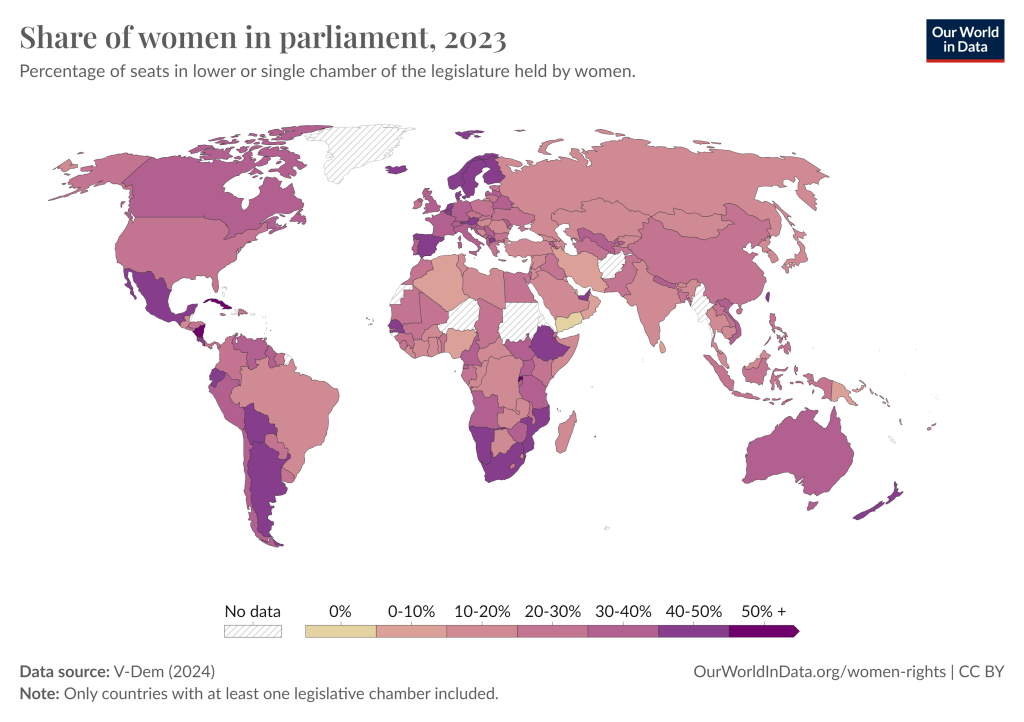
So why is it that not enough women run for office or get elected in Ireland? If we look at the statistics in Europe, Ireland has the 6th lowest rate of female participation in lower houses of parliament, only 26.5% of parliamentarians in single or lower houses are women globally, this has risen from 11% in 1995. There has been a steady rise globally of women in politics visible from the 18th and 19th centuries where women did not have the right to vote or sit in parliaments. According to the United Nations only six countries have 50% or more women in parliament globally, Rwanda have 61%, Cuba have 53%, Nicaragua have 52%, Mexico have 50%, New Zealand have 50% and the United Arab Emirates have 50%.  In 2008, Rwanda became the first parliament to have more than 50% women, the first women-majority parliament. The UN also recorded last month that there was 28 countries that had women serve as Heads of State and/or Government. At the current rate it will take 130 years to reach gender equality in the highest positions of power.

In Ireland

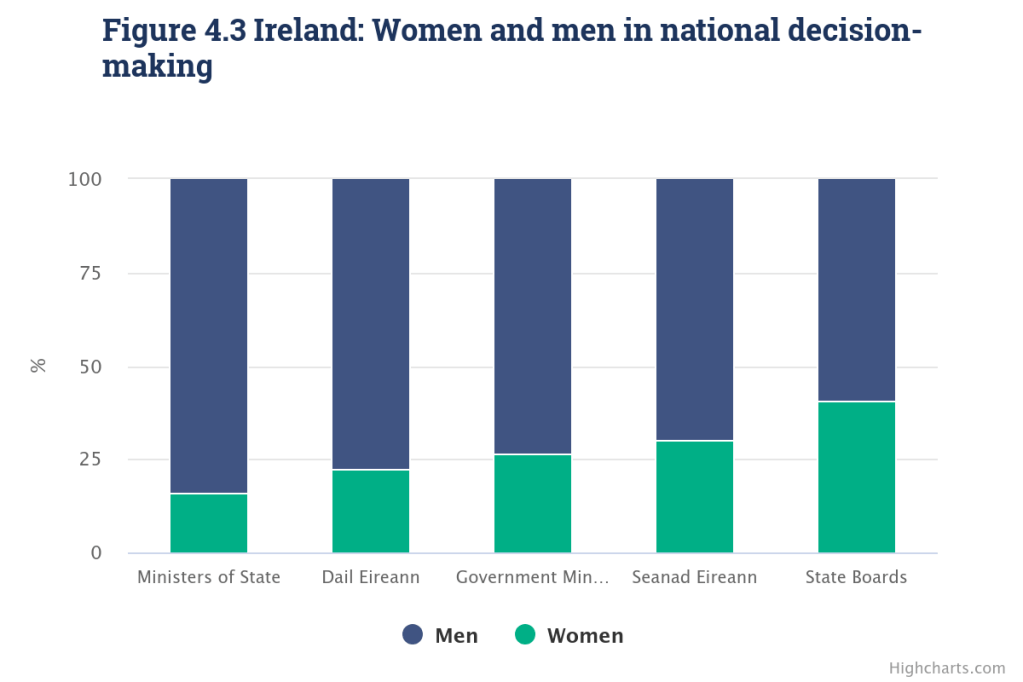
In Ireland, 21.1% of TD’s are women, 38.3% Senators and 25.9% are County Councillors. Barriers exist for women, the “5 Cs”, confidence, childcare, culture, cash and candidate selection are some of the obstacles faced. I recently spoke with a female councillor who sat in a very “traditional Borough” in the North of Ireland. She only ran once as she found it difficult being in a minority, especially when gender sensitive topics arose, she found it “unbearable”. In many cases in our patriarchal system women are still expected to be the main care giver in the home, this limits availability and commitment. We are also resistant to change, traditionally politics has been male dominated and people are reluctant to nominate or vote for someone different. However, voter loyalties to political parties is in decline, elections have become unpredictable. Anti establishment sentiment and positions are contributing to the changing shape of the party system. I believe this will cause more barriers to leveling up women in politics.


Moving Forward

We need to change the dynamic of the political system in Ireland, a change that is reflective of an ever evolving society. Implemented by and includes more women, we need more working-class women, migrant women, Traveler women, rural women, disabled women, more women from the LGBTQI community. Only then will all women be represented here. A 50/50 gender balance in government is key to Ireland becoming a thriving and vibrant society. This quota needs to be met and surpassed. Imagine having a women’s perspective on housing, healthcare or the justice system. How much fairer and more efficient it could be.

There has been a push by various organisations to get more women elected, however, as mentioned by Rachel Coyle, Head of Campaigns and Mobilisation for the National Women’s Council, more women ran in local elections that saw women from diverse backgrounds being elected. However, it still remains that women will only make up around 26 % of Councillors which is the same percentage of outgoing women Councillors.

While a record number of 677 women contested the elections, up from 566 in 2019, it was only 31% of overall candidates. There was an increase in migrant women contesting the elections, however, no Traveller women sought election and in two constituencies, Moate in County Westmeath and An Daingean in County Kerry, no women ran. Local elections are a clear route to national government and both of the two main parties  Fianna Fail and Fine Gael failed to meet the 40% quota, failing to even reach 30%. The latest data available in the infographic below compiled by the Central Statistic Office paints a grim picture of women in decision making roles.

In Donegal with thirty-seven seats to fill there was a record nighty one candidates that contested the local elections. Of those elected just three were women from seven electoral areas, one down from the 2019 elections. Joy Beard who ran for the first time was elected on the first count in Buncrana, and Dakota Nic Mheanman was elected in the Lifford-Stranorlar local electoral area. Both Beard and Nic Mheanman are affiliated with the 100% Redress party and Sinn Féin respectively. While Niamh Kennedy retained her seat as an independent candidate in Donegal. 

So why is it so important that we encourage more women into politics? Public representation should be diverse, representative of the society we live in. This will benefit all of society promoting a rounded and balanced decision-making process. County Councils implement procedures and make decisions that affect the places where we live, work, and relax whether its affordable housing, road works, environmental issues, providing playgrounds or leisure facilities. Governments make decisions that affect us at a global level. Decisions made by elected representatives affect our everyday life, so it is crucial that women play an equal part in that decision-making process.


Upcoming Women in Local Leadership (WILL) programme in Donegal

Let’s celebrate and support women in leadership together! Join the new Women’s Collective Ireland-Donegal programme starting on Tuesday 17th September 10am-1pm in Donegal Town. This is a FREE 8-week programme for women and a space for you to explore what leadership means and develop your skills and confidence. Over the sessions you will learn about local government structures and voting with a field trip to local government in Lifford and with the opinion to visit Dáil Éireann, look at equality and human rights issues, think critically about lived experiences, gender equality and issues that hold back women’s equality and participation in society. Exploring ways to empower and support those affected by gender discrimination.

If you would like to take part in this programme please fill in our form here https://forms.gle/fUvymoZNasTv8T8n8 and we will be in contact. For more information please email WCI-Donegal on donegal@womenscollective.ie or text us on 085 8638419.


WCI-Donegal are always looking for women to share their stories and looking for women to write features on topics of their choice which we will profile as part of our Women’s Lives, Women’s Voices’ series.

Writing for Wellbeing


This Women’s Collective Ireland-Donegal, ‘Women’s Lives, Women’s Voices’ feature is written by Siobhán Mc Laughlin. Siobhán is a poet and writer from Donegal, she has a MA in creative writing and is a creative writing facilitator who has been facilitating writing for wellbeing courses with women for WCI-Donegal this year. In this feature she reflects on the benefits of writing for wellbeing, talking about her own experience of writing and what she has discovered along the way


Writing for Wellbeing is a relatively new practice in the wellness field, but as anyone who writes knows, writing has always had therapeutic benefits. It’s just now they are being recognised.

If you’ve kept a diary at any stage in your life, you will be very familiar with this. A diary during those teenage angst years was a great way to vent all your turbulent feelings, from daily dramas to heartbreak crushes. Those pages of gushing would provide comfort and consolation, a listening ear, a way of uncorking all those bottled-up emotions. (And there was a reason why they used to come with a lock and key!)

Writing is a way to clarify thoughts, to unravel the jumble of them into clear concise visible ideas. Do you keep a to-do list? The power of such a simple thing to keep your head clear of worrying about things is very evident. When it’s written down, it’s out of your head and onto the paper. Like a magic spell, the words hold it there; it is no longer your mind’s job to do so. It can let go and relax.


To write something – to put your thoughts into words and onto paper – provides you with the space to listen to your own voice. Your real voice. Your inner voice. The one that is so often quieted, by other louder insistent voices in your life. To put pen to paper is to silence those other voices and like turning a radio dial, to tune into yourself again. Journalling is keeping a record of the story of your life, as told by you. And stories help make sense of things.

I’ve been writing since I was a child. Diary writing, story writing, letter writing, poems, blogs.  I loved the escapism of creative writing and later, the hyper-realism: how you can lose yourself in writing and simultaneously, find yourself there. Writing helps me work things out. It dissects emotions and feelings under the light of attention. It helps me unravel knots of thoughts and find out what I really am thinking/feeling. I would be lost without it.


I kept a diary/journal into my twenties and into it poured all my worries and wonderings, rantings and musings.  It was a catalogue of growing up, a space for reflection, and with reflection comes self-knowledge. It was where I examined with each word and sentence what exactly was going on in my life and what my responses to it were. It was a way to commune with my true self. When writing about things, I felt like I was making them ‘right.’ Telling myself the story of my life was a way to appreciate it as such and to look at it from a more knowledgeable perspective. Looking back on that time I can really say it was an invaluable practice.

Writing is a great way to express feelings. To get them ‘off your chest’ and out onto the page. There’s a great word for this from Greek called ‘catharsis’ – the act of releasing pent-up or repressed emotions. When you write about these feelings, they leave you. They are expressed. This is essential to our wellbeing. Therapists recommend it all the time. To write about how you are feeling acknowledges the feeling and puts you at a distance from it. In writing about it, you can translate and transform it, until you gain a sense of peace and move on from it.


Poetry is an excellent way of doing this.  Poetry allows us to decode emotions, explaining them to ourselves through its tools of symbolism, metaphor, imagery.  If I can contain an emotion within a poem, then it is stored somewhere else other than my psyche. The power of poetry to translate emotions is incomparable, I think. It is: ‘when an emotion has found its thought, and the thought has found words’ (to quote Robert Frost). I always think of emotions as these vaporous, glowing entities, hard to grasp as they slip and shimmy about us. But poetry helps solidify them, catch them with a net and shine a light on them. What is this thing and how am I experiencing it and what does it have to teach me? Writing a poem is a journey and always at the end of it, there is understanding to be found, which offers the greatest sense of wellbeing. It’s my go-to method of dealing with strong emotions.

Did you know that writing about positive experiences for as little as 15 minutes three times a week can significantly boost feelings of wellbeing and reduce stress and anxiety? You can write a daily diary entry, or a journal topic or perhaps some little scribbled notes of a poem or an idea for a story. Or gratitude journalling – just jotting down three things you are grateful for at the end of every day. Within a year you will have hundreds of little footnotes of joy. Things we may forget completely if they are not immortalised in words. Writing gives power to things. You are creating a world for yourself with words. A better world that will improve your mindset.


Writing is also an exercise in mindfulness. As I type this article I am lulled by the rhythmic tapping of keys and the timbre of thoughts. It is the same when you handwrite something, the pen carries you along in the moment. The blank page quietens the mind. It focuses you on the moment, on each word as it comes. Writing attunes us to the present moment and keeps our minds from wandering.

I really began to think about the wellbeing aspects of writing during Covid. During the lockdown I set up a Facebook group for friends and writers I knew to come together where we could share daily writing as a way of easing the stress of the time. Something quick and easy, like haiku. A haiku is a short three-line nature-based poem, rooted in paying attention to the present moment. From all over the world, members would post in their daily offerings of haiku, usually more than one in the day. We were suddenly, collectively, paying attention to moments of peace and beauty in our lives, despite the strange, unsettling time we were living in, and these little moments became so important to us. They were a comfort, a calm, a nucleus of loveliness. Three little lines of uplifting observation. The group is still going today. We haven’t been able to give it up! Just spending a few minutes in the day to scribble a couple of lines lifts the spirits so much and shifts mood. This is the power of writing.


In 2022-2023 I facilitated a weekly series of Writing for Wellbeing workshops at Foyle New Horizons: Action Mental Health in Derry. I got to meet so many wonderful people there who were so open to the benefits of writing in their wellness journey. I facilitate a lot of writing classes and workshops, but I find Writing for Wellbeing ones really inspiring. I welcome every chance to facilitate them and share the benefits of writing with people and have been lucky to do so in the past few years with groups like Insight Inishowen to promote positive mental health. People tend to open up and share their innermost thoughts and feelings with each other in these workshops which is truly inspiring. All of the creative arts are so beneficial for wellbeing, but writing in particular is quite a powerful one in bringing us face to face with a better understanding of ourselves and of the human condition.

It makes me sad to think that some people may have a resistance to writing because of things like grammar and a feeling that they would not be able for it. There is no right and wrong when it comes to writing. It is not a test. You write what you want to write. What calls your heart. In whatever form it may be. Don’t be put off by things like grammar and rules. Break the rules! Poetry doesn’t have to rhyme! Journal entries don’t have to be pages long! Don’t tell yourself you have nothing to write about. We all have our own stories. Don’t silence them. Writing, unlike some of the other creative arts, costs nothing in terms of material needs. All you need is a pen and paper. You do not need an easel to begin or a set of fancy pens or a predisposed talent. Just begin with scribbles. See where they take you.


Writing will surprise you. That is a guarantee. Every time you put pen to paper, you are led on a journey. You will discover reservoirs of insight and wisdom you didn’t know you had; a lot of writing feels like you are taking ‘dictation’ – listening to some other source, and not writing it yourself. Any writer will tell you this is the best part of writing. Like free-falling. The part when we transcend our blocks and critical hang-ups and tune in to our authentic, wise, and inner selves. And it just flows.  

Julia Cameron, author of The Artist’s Way said that ‘writing is medicine.’ It makes us better. It cures us of our ailments. It is a companion to life’s changes. It is certainly all that. And a welcome addition to the world of wellbeing.


Siobhán’s poems have been published in numerous publications including The Honest Ulsterman, The Ekphrastic Review, Drawn to the Light Press, The Poetry Village and more. She featured on Donegal Daily’s We are the Poets Series 2020 and Eat the Storms, TER and Absolute Writers Podcasts. She volunteers with mental health charity Insight Inishowen.

She blogs at www.a-blog-of-ones-own.blogspot.com and www.a-poem-a-day-project.blogspot.com


WCI-Donegal are always looking for women to share their stories and looking for women to write features on topics of their choice which we will profile as part of our Women’s Lives, Women’s Voices’ series.

Life as it’s meant to be


This WCI Donegal, ‘Women’s Lives, Women’s Voices’ feature is written by Helen O Driscoll. Helen has led a varied life full of excitement and exuberance, but the essence of Helen is best described as someone who has a massive welcoming smile who loves to help others holistically. This is Helen’s story.


Being born on a dairy farm in West Cork has cemented my love for nature and Mother Earth and I realise it has, and continues to be, a rich resource for me as I navigate this journey called ‘Life’!! Being in nature, the sea, the woods etc is my safe place. We all need to identify what helps us most when we are going through the not so ‘sparkly’ times in our life and whatever that is, be it music, dancing, nature, crafting, writing, storytelling etc. Finding out what soothes our soul is essential, or at least it has been for me as I travelled and lived in London, Preston, Glasgow, Middle East, Australia, Spain and other European places. Finally landing back in Donegal some 7 years ago, a place where nature and the sea is in abundance.

Perhaps it was this early nurturing of animals that led me on my path to becoming a nurse, and gaining over 30 years’ experience, working in a variety of clinical settings. Starting my career in the nursing medical field I moved on to specialise in the Intensive Care (ITU) working in general, cardiac, burns and pediatric (ITC), in the UK, Ireland and the Middle East. Witnessing first- hand the experience of trauma and the body’s capacities to heal, the first seeds were scattered, germinating later in deeper study in this area.


From nursing I moved into the corporate arena, working for a number of large American multinationals, predominantly in the area of wellbeing, absence, project and change management, and employee assistance programmes. I was responsible for setting up the UKs first ever telephonic Disease Management Programme, as well as co designing and delivering one of the first ever Case Management programmes in the UK, wellbeing being at the core of both these programmes. Because of my long-standing interest in wellbeing and body work alongside my clinical and corporate roles, a life-long passion and commitment to individual’s wellbeing and a deep curiosity about body mind medicine, I trained as a Master Practitioner in Reiki, Neuro Linguistic Practitioner (NLP – Master), Emotional Freedom Technique (EFT- Level 3) and Integrated Energy Therapy (IET- Level 3)). I also completed the Mindfulness Based Stress Reduction (MBSR) course, Mindfulness in Schools (BiBo,) Breath Mastery and Tension Release Exercises (TRE),


My day job as the NW Living Well coordinator (a free HSE programme for people living with chronic conditions) and my additional roles as a facilitator with two Mental Health charities reflect my long-standing love and interest in facilitation and wellbeing so I went onto complete my Masters in Advanced Facilitation for promoting Health and Wellbeing, receiving a first-class honor. I witness a magic that unfolds when facilitating groups and wanted to learn the academic side of that also, along with a healthy dollop of how our own personal pieces affect a group.


Over the years I have read, listened to, and generally immersed myself in anything relating to understanding how our minds work, how emotions and especially unresolved emotions affect us. I recently furthered my study with two energy psychology modalities that specialise in subconscious reprogramming called Belief Coding®(uses elements of Psychology, NLP, CBT, EFT, Meditation, Matrix-Reimprinting, Emotion Coding, Kinesiology and Energy Healing and is accredited by the CBD Certification process) and Mind Navigation. These latter modalities being especially valuable where there has been an impact through trauma. My interest finds expression in the constantly emerging mind body field and brings together all my knowledge and the bespoke workshops that I create design and facilitate reflect this. This led naturally to running my first retreat in Jan 2023 with a particular focus on the Sacred Divine Feminine.


Fashion psychology is of particular interest to me and I completed a fashion diploma! I am an avid charity shopper with 90% clothing coming from there. From my research I got to know what I have always felt is the way we dress adds another dimension to ones overall wellbeing. This interest has lead to the development of my courses “Do You Wear You” (DYWY) and “Do You Show Your True Colours” and I am looking forward to delivering the DYWY course this May, in a couple of libraries, as part of the Bealtaine celebrations in Donegal.


Alongside all of this, I have been exploring, experiencing and deepening my interest in spirituality. You could say I am out of the ‘Spiritual closet’ as I truly believe that spirituality fills in the gaps that intelligence and emotion fail to fill. Victor Frankl (2000) in his book ‘Man’s Search for Meaning’ says that a person is body, mind and spirit and who had a feel for a higher essence, could withstand much hardship, despite desperate physical conditions.


My extensive travels have included the Pyramids of Giza, Machu Picchu in Peru, Acropolis in Athens, Coliseum in Rome, Angkor Wat in Cambodia, and many more destinations. My travels are for me, reminders that humans have always had this desire for the ultimate purpose or meaning of life, and that my ancestors have grappled with a desire to connect with something beyond their existence. Living my own life, I have a deep knowing that there is more. As a result I am open to change and growth and all of the other ‘spiritual ingredients’ required for a fully rich and nourished life. As Rumi’s (n.d.)says ”I looked in the temples churches and mosques. But I found the Divine within my heart”.   I move towards anything that enriches this in me, as it helps to avoid the hardness that can come with life’s wounds that we all experience.


John Moriarty was recorded in a conversation with Tommy Tiernan in which he says that dolphins who had been land animals went down to the sea and said to the ocean ”shape me to suit you”. What a great way to live life, full of trust that all is unfolding as it is meant to because we are all part of the greater mystery and it is certainly how I always aim to live this life of mine. Staying with the theme of trusting how life unfolds, I recently did the Sexual Health and Wellness Course as part of my continuous professional development and among the many things I learned on this course, was the lack of real education around sexuality, more especially the big gap that that there is  between spirituality, sensuality, and sexuality. I am stepping up into how life wants to shape me, so to bridge this gap in sexual and spiritual education, my friend Siobhan and I are organizing a live event called ‘Enlightenment in the Bedroom’. We will be presenting cutting-edge conversations that unravel the mysteries around sexuality, sexual wellness, relationships and intimacy that are relevant to all our lives and all our experiences. Come with an open heart and an open mind and you are guaranteed to leave with insight and information that will make a difference in your life. You can find details here.

WCI-Donegal are always looking for women to share their stories and looking for women to write features on topics of their choice which we will profile as part of our Women’s Lives, Women’s Voices’ series.

Let’s Celebrate Women Farmers in Donegal


This feature is a Women’s Collective Ireland- Donegal, ‘Women’s Lives, Women’s Voices’ feature. Written in celebration of Rural Women’s Day to raise awareness to the role Donegal Women play in agriculture and rural development. With an inspiring afternoon at The Milk Bar with its founder Shannon Porter


Did you know Sunday 15th October 2023 marks International Day of Rural Women? The day was first observed in 2008 to recognises the role of rural women, including indigenous women, in enhancing agricultural and rural development, improving food security and eradicating rural poverty.

It was suggested that October 15 be celebrated as “World Rural Women’s Day,” which is the eve of World Food Day, to highlight rural women’s role in food production and food security. “World Rural Women’s Day” was previously celebrated across the world for more than a decade before it was officially a UN observance. The theme for this day is “Rural Women Cultivating Good Food for All”, which highlights the essential role rural women play in the food system.

At Women’s Collective Ireland-Donegal we felt it was important that we take the opportunity to celebrate the contribution and successes of the women working in agriculture and rural development locally here in Donegal. During the summer WCI-Donegal development worker Rhona Hannigan took a trip to the Milk Bar to interview Donegal local farmer and the Milk Bar founder Shannon Porter to see the great work she is doing in Dairy farming and the business she has created.


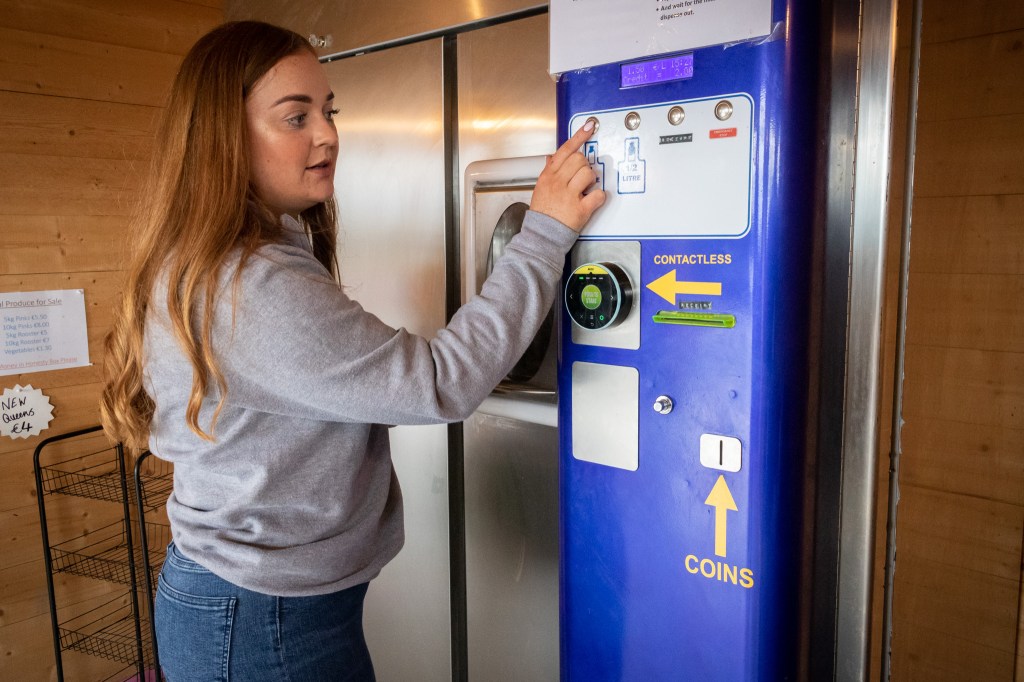
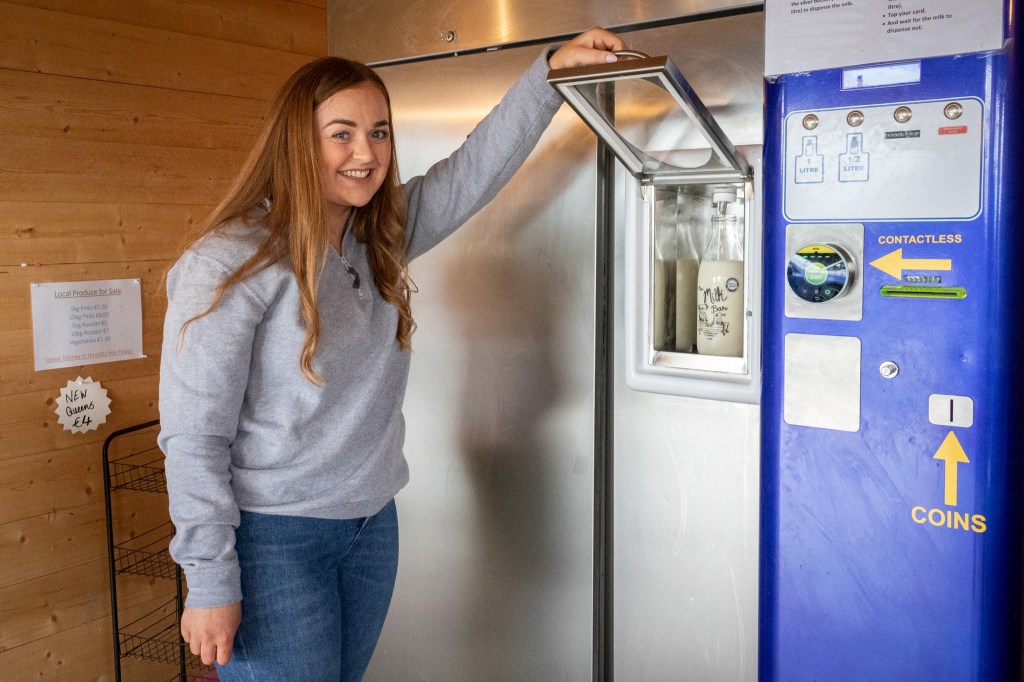
The Milk Bar opened its doors on the 24th of September 2021, an innovative concept of local girl Shannon Porter. Shannon grew up on the family dairy farm in Lusticle, Carrigans in the North West of Donegal. Chatting with Shannon it is evident that she is passionate about dairy farming, she has managed to turn her passion into a thriving business that is going from strength to strength. The Milk Bar is situated on the family farm and uses the freshest milk that is pasteurised on site, but it is not homogenised, leaving the creamy layer on top.


Shannon’s passion for the agriculture sector developed from growing up on a large farm, both her parents come from a farming background and passed on their skills for sustainable farming with an innovative approach. The family business dates back to the 50’s and 60’s when Shannon’s great grandfather Jack and great grandmother Henrietta Porter started to provide milk to the village, known as Millburn Dairies. In those days you collected the milk at the dwelling house in a tin can. Later the milk was delivered in glass bottles to your doorstep. Over time the glass bottles were replaced by milk cartoons and plastic containers. ‘The Milk Bar’ has reverted back to glass bottles with sustainability at the forefront, reducing the use of plastic. Shannon got the idea when she studied Agricultural Science at university, graduating with a BSc Honors Degree in Agriculture from Harper Adams University. She set up the business during covid which was risky, but it proved successful because of the self service vending machines. The milk itself is beautiful, fresh and a novel idea that promotes local produce.


Shannon choose a general agriculture course that covered all areas of agriculture from livestock, crops, business, environment and sustainable farming. While studying Shannon worked on dairy farms of varying sizes to support her studies and to expand her knowledge of the sector. Getting experience from the farm at home, to working in the UK and New Zealand, developing practical farming skills in all areas of agriculture. Shannon’s talents were recognised at University when she was a finalist for the Royal Association of British Dairy Farmers Dairy Student Award 2021. She was runner up in 2022 in the Food Coast Donegal Awards and a finalist in Blas na hEireann Irish Food Awards in 2023 for her milk and ice-cream. A growing number of local businesses are selling and using the milk now. Its freshness and creaminess makes a hugh difference when making frothy coffees Shannon mentioned.


The farm produces around 6ooo litres per year, most of which is sold to creameries, the milk is collected every two days, processed and then sold to consumers. It is worth noting that the milk in the Milk Bar is straight from the farm, pasteurised on the farm, as fresh as you can get. As a businesswomen profit is important but animal welfare also features highly. With Shannon at the helm I have no doubt the business will continue to thrive and diversify.

Farming is not a traditional route for women, increasingly gender balance is being achieved in most sectors, however, in Ireland only 13% of farms are owned by women. A situation contributed to the fact that men in Ireland significantly outnumbered women as the holders of family farms. In 2016, male ownership stood at 88.3% compared with 11.7% female ownership. This can be attributed to a myriad of social, cultural, legal and financial reasons for the low rate of female farm ownership.

But change is happening and the innovation and vision of young women like Shannon, provides an example to other women who may want to create a future in farming. Women in farming has been an area we have highlighted before, in 2021 as part of our Donegal femLENS exhibition, we feature two thought provoking documentary photography projects which focused on women in farming, you can view these projects here “Focus on Female Farmers” and “The Farm Hers”.


Women’s collective Ireland-Donegal would like to thank Shannon for inviting Women’s Collective Donegal up to the farm and taking the time to show Rhona around and take part in the women’s lives, women’s voices series. Shannon is a role model for young women in Donegal and beyond. We would also like to thank femLENS participant Maud McClean, who volunteered her time and budding photography skills to take pictures for this rural women’s day feature.

We are always looking for women to share their stories and looking for women to write features on topics of their choice which we will profile as part of our Women’s Lives, Women’s Voices’ series. If you would like to get involved please drop us an email at donegal@womenscollective.ie