Archives

Hope Beyond Violence-Creating Safer Communities for Women

In this women’s lives, women’s voices feature, we will delve into the issue of domestic violence and look at the rise of femicide in Ireland, which is not defined in Irish law. Femicide is a growing social issue in our society and we need to create awareness around it and start calling it what it is, the gendered murder of women or girls.  Written by WCI-Donegal Development Worker Rhona Hannigan


Domestic violence, sometimes referred to as domestic abuse or intimate partner violence, is a serious and pervasive issue in Ireland, affecting individuals across all ages, genders, and backgrounds. It involves patterns of coercive, controlling, threatening, degrading, or violent behaviour which may include physical, emotional, sexual, and financial abuse, typically by a partner, ex-partner, or family member.

In Ireland, domestic violence has historically been a hidden problem, often shrouded in stigma and silence. However, increased public awareness, changes in legislation, and the work of advocacy organisations have brought the issue into greater focus over recent decades.


Women represent the most recorded victims in Ireland. Almost a third of all women have experienced physical and, or sexual violence by their intimate partner. According to data from Women’s Aid and the Central Statistics Office (CSO), thousands of cases are reported annually, however the majority of incidents remain unreported due to fear, shame, or lack of trust in authorities.

According to Safe Ireland:

“In Ireland, 1 in 3 women have experienced psychological violence from a partner at some point in their lives and 1 in 6 have experienced physical or sexual violence by a partner since the age of 15.


According to the United Nations, in 2023, there were approximately 51,100 women and girls murdered worldwide by their intimate partners or other family members. This means that, on average, 140 women or girls are killed every day by someone close to them. This is the ultimate and extreme culmination of continued acts of violence against victims.

Femicide represents the dramatic end-point on a spectrum of violence against women. Femicide is driven by discrimination against women and girls, unequal power relations, gender stereotypes or harmful social norms. It is the most extreme and brutal manifestation of violence against women and girls which occurs on a continuum of multiple and related forms of violence, at home, in workplaces, schools or public spaces. Which includes intimate partner violence, sexual harassment and other forms of sexual violence, harmful practices and trafficking. As many as 38% of all murders of women are committed by intimate partners, according to the World Health Organisation.


From a statistical perspective, it is difficult to define numbers of femicide in Ireland as there is no working definition. The European Institute for Gender Equality (EIGE) defines femicide as ‘killing of a woman by an intimate partner and the death of a woman as a consequence of a practice that is harmful to women”. It is understood that an intimate partner can be a former or current spouse or partner, whether or not the
perpetrator shares or has shared the same residence with the victim’.

In a joint report by UNODC and UN Women in 2023, more women and girls were killed in 2022 even as overall homicide numbers fall. The research recorded that 89,000 women and girls were intentionally killed globally in 2022, the highest rate in twenty years. The true numbers are likely to be much higher as records only relate to intimate partner killings. Murders of women that occur as a result of rape, sexual violence, honor killings or female genital mutilation are recorded as murders and therefore are not attributed to femicide.


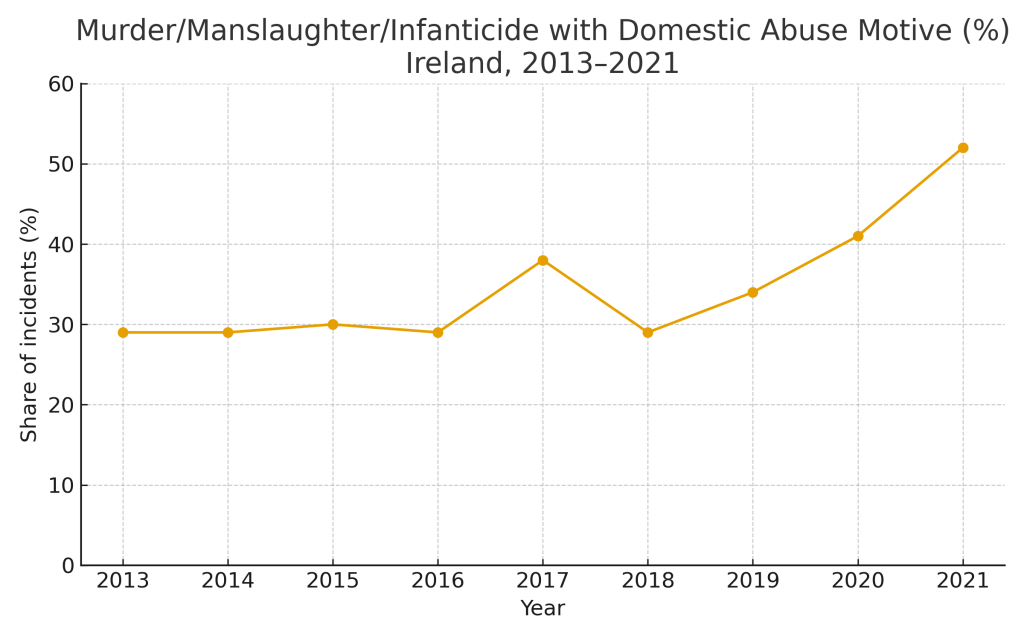
In a Garda report, “Domestic, Sexual and Gender Based Violence”, released in 2022, males and females experience violent crimes differently. In the case of female victims there is a close link with domestic abuse and sexual violence crimes. Between 2019 and 2021 a motive attributed to domestic abuse was recorded for 90% of women who were victims of Murder or manslaughter. Whilst Male victims also experience domestic abuse, they are more likely to be subject to violence by offenders unknown to them or in incidents not relating to domestic abuse.


The graph below by An Garda Síochána shows the annual number of Murder/Manslaughter/ Infanticides incidents between (2013–2021)

Domestic violence remains a critical issue in Irish society, requiring ongoing awareness, prevention, and support efforts. While legal reforms and advocacy have made progress, continued work is needed to ensure that all victims feel safe to come forward, receive protection, and rebuild their lives free from abuse.

Building Community Solidarity

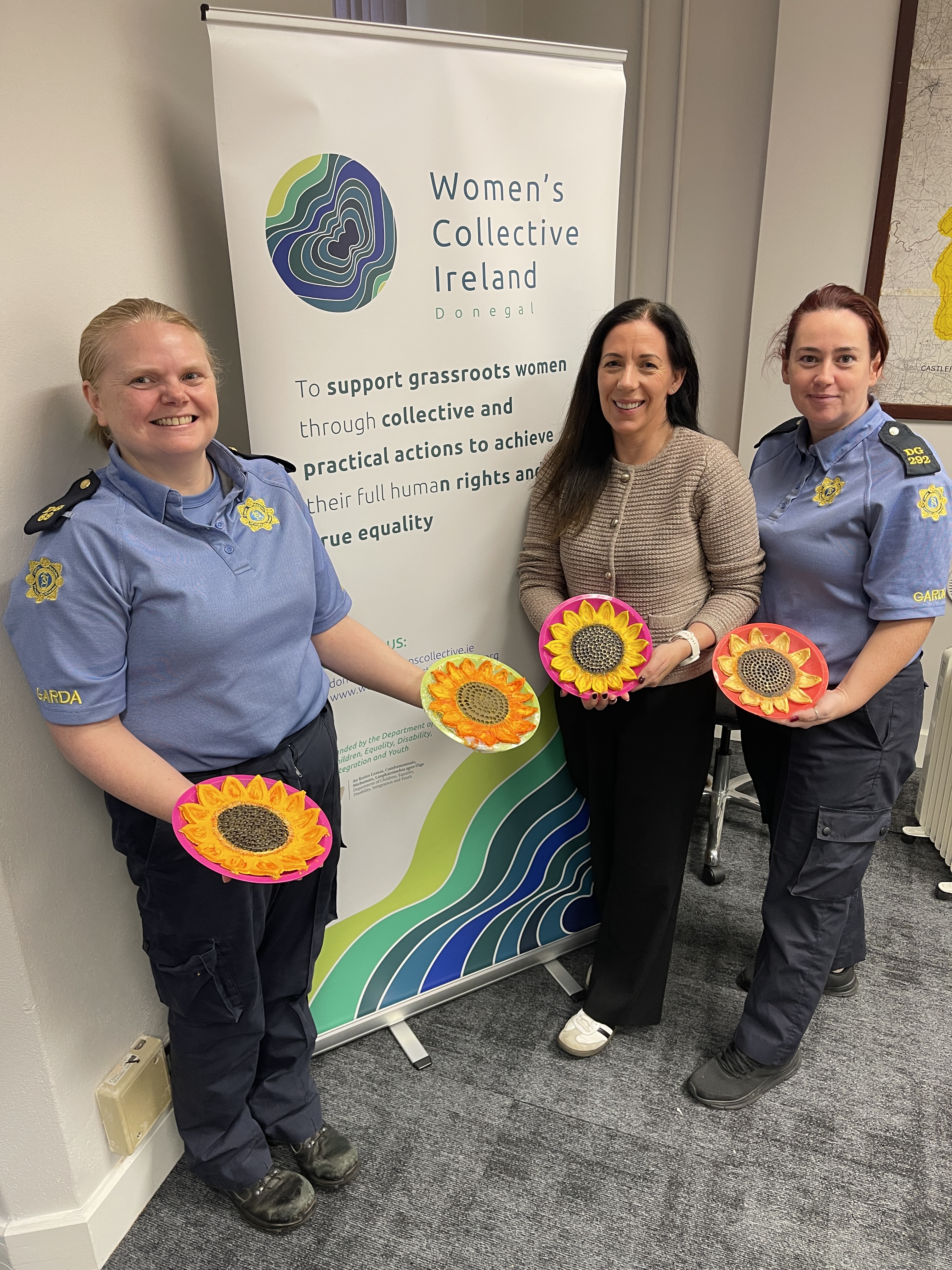
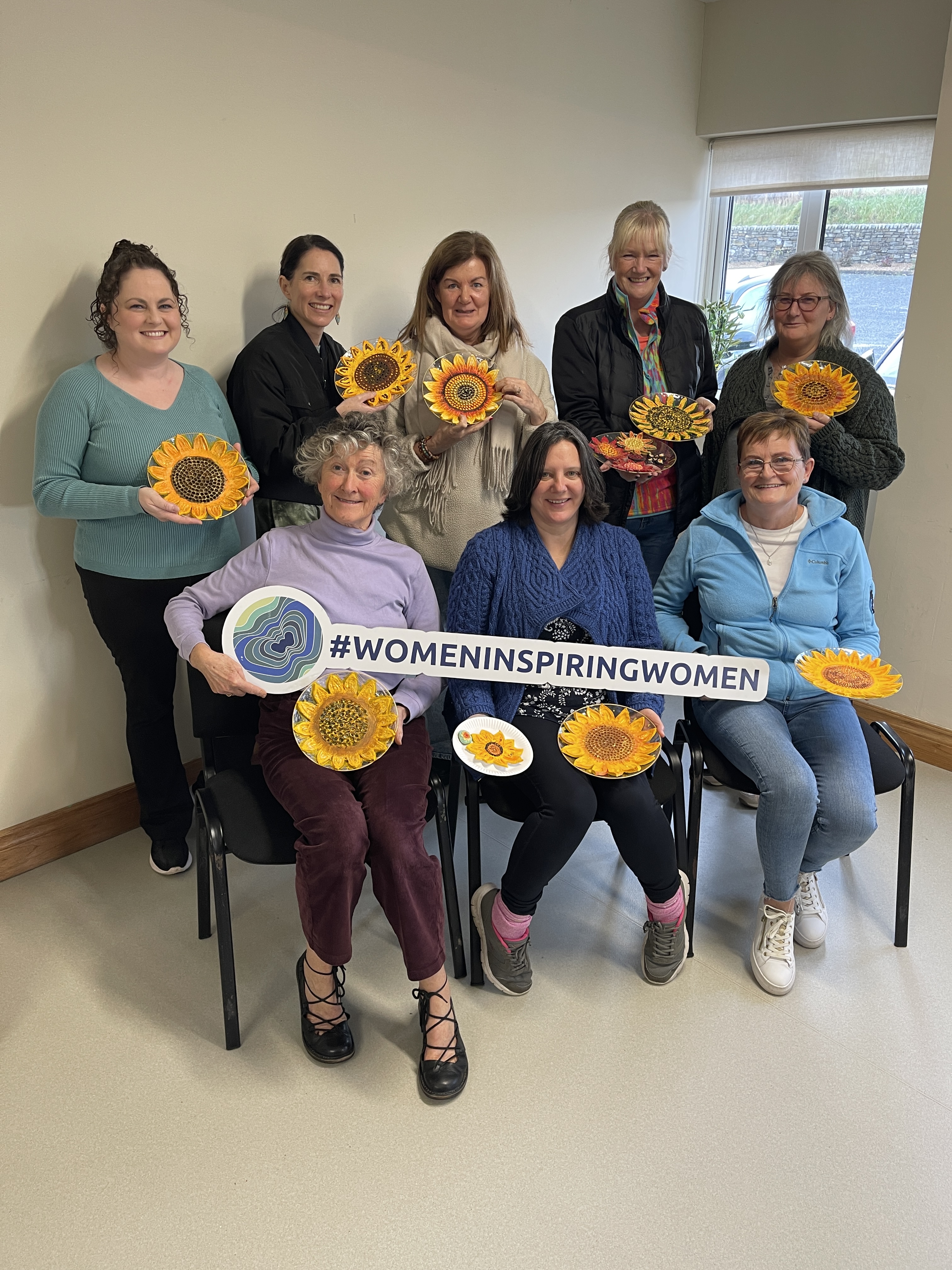
Between October and November 2025, Women’s Collective Ireland–Donegal worked with different groups in Donegal. These included the Early Birds Pettigo Women’s Group, Donegal Town Crafting for Connection Group, Rossnakill Community Hub, AIB staff from Donegal Town, Killybegs, Ballyshannon and Ballybofey, members of An Garda Síochána Donegal, and the ATU Donegal Empower Her Society.

The project highlights the reality that 1 in 3 women experience gender-based violence. It aims to remind women that they are not alone, that support is available, and that communities have a role to play in challenging violence and creating a safer future for women and girls.

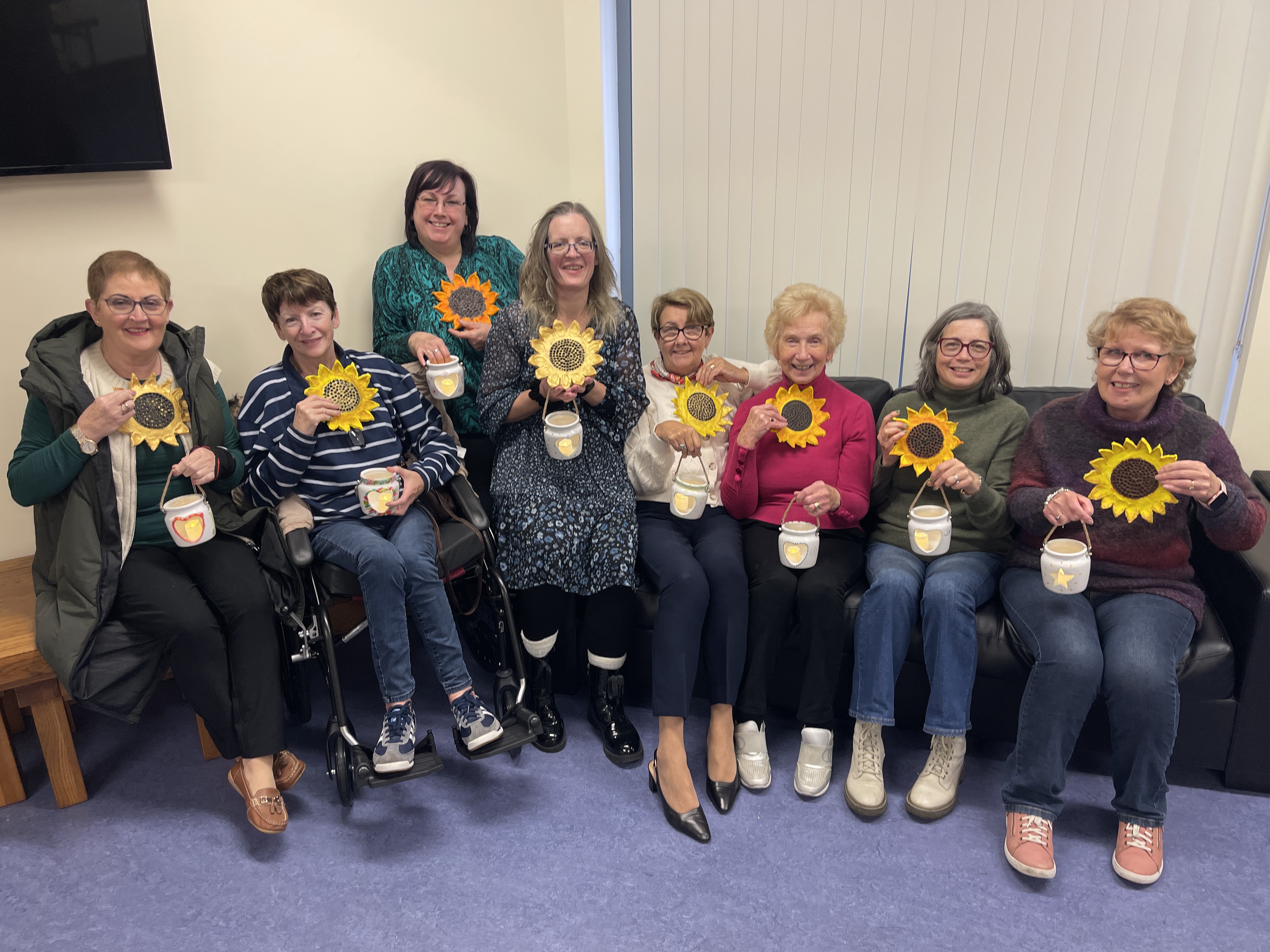
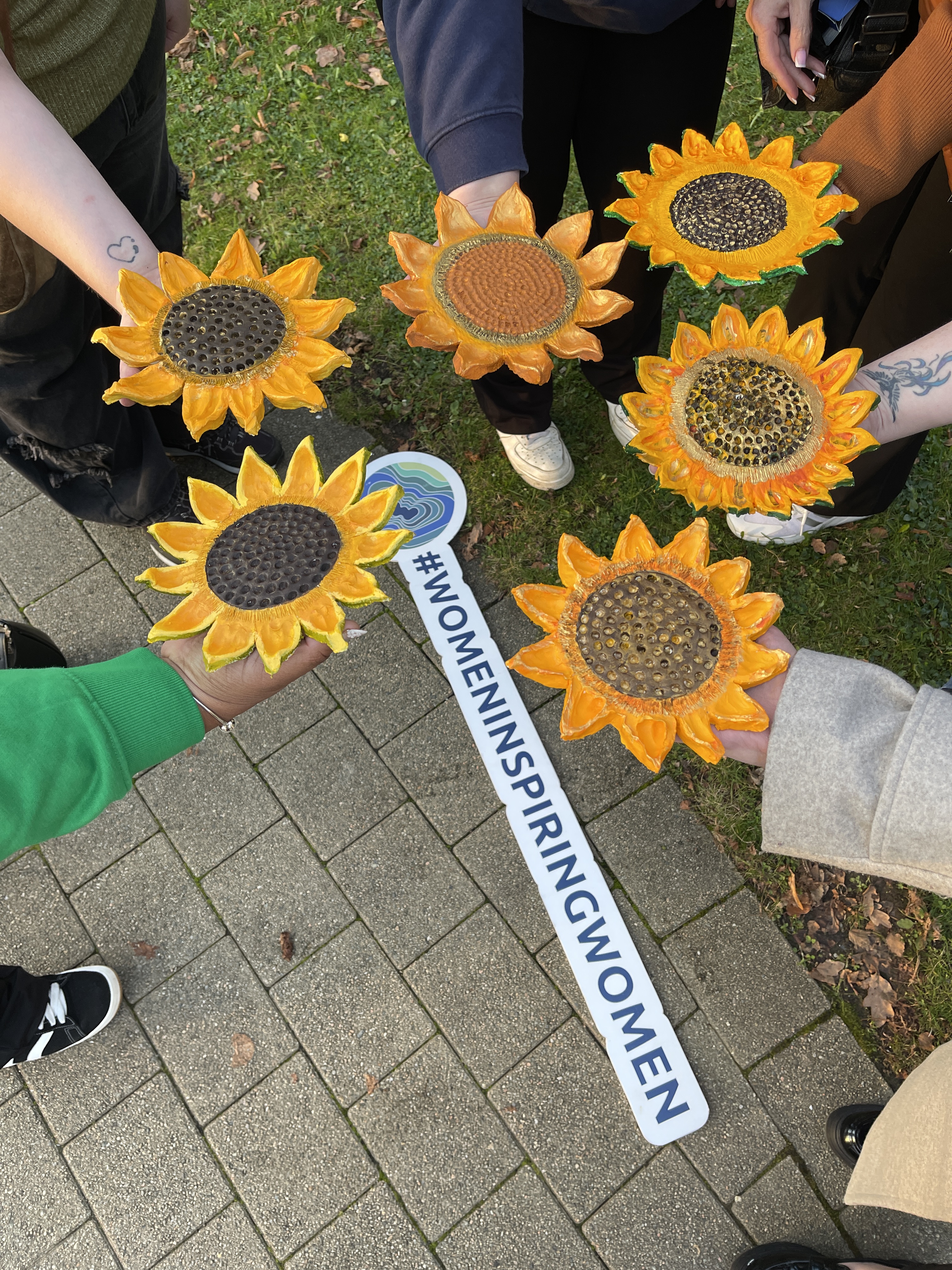
Each group created handcrafted clay sunflowers under the motto:

“Be like a sunflower, so that even on the darkest days you stand tall and find the sunlight.”

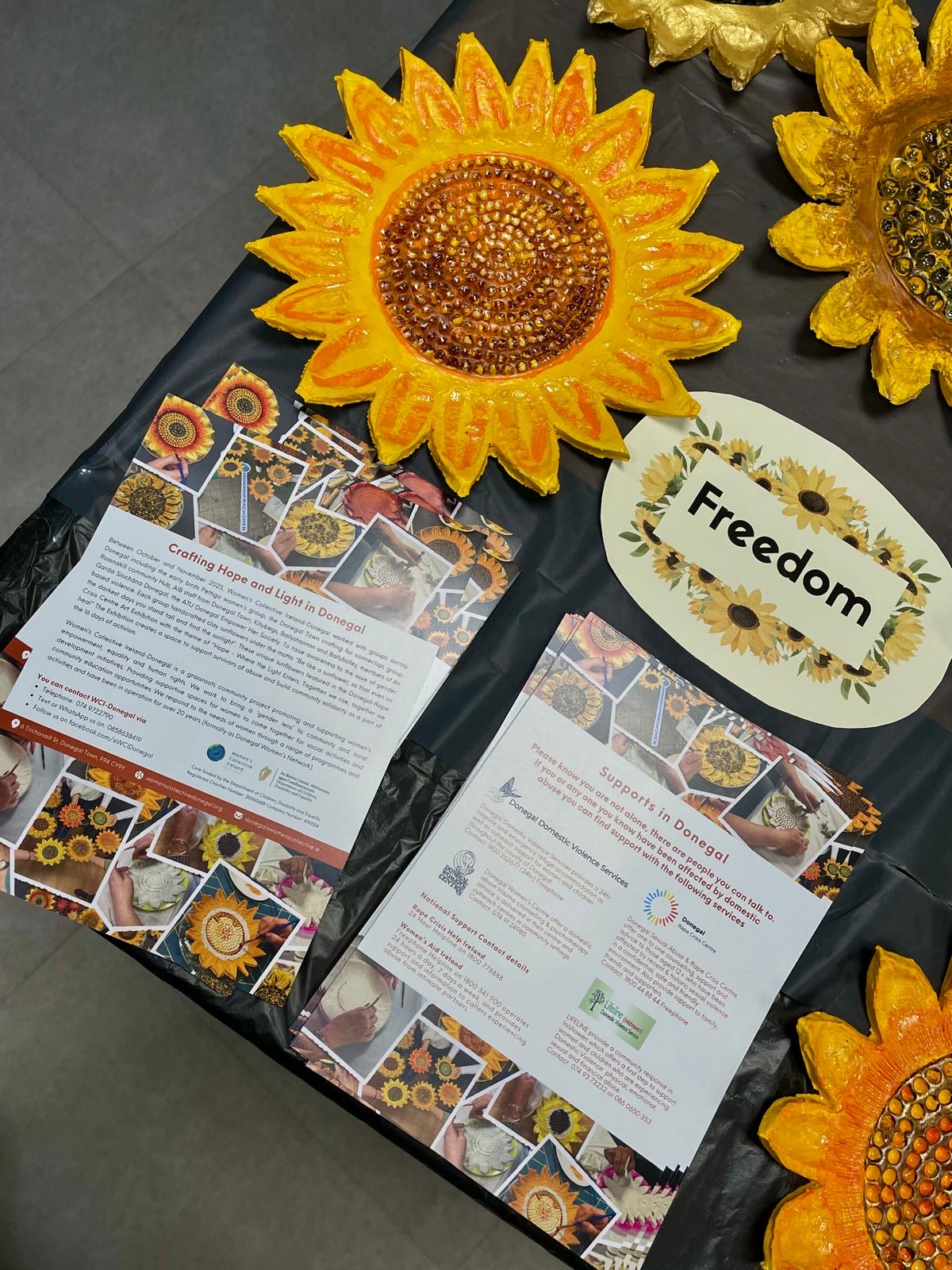
The sunflowers were first displayed at the 2025 Donegal Rape Crisis Centre Art Exhibition in Letterkenny. The exhibition theme was “Hope – Where the Light Enters. Together we rise, together we heal” and took place as part of the 16 Days of Activism, creating a supportive space for survivors and promoting community solidarity.

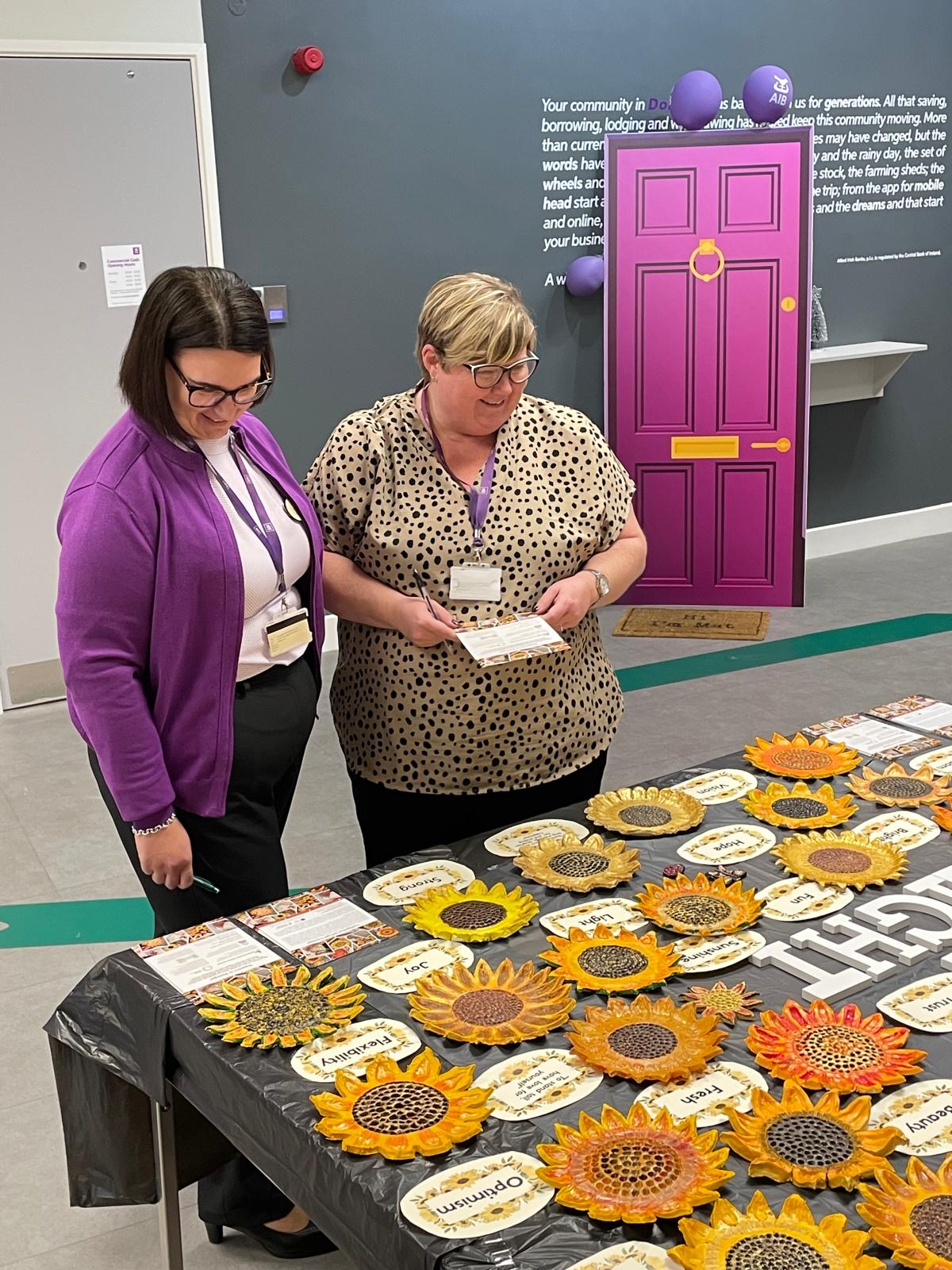
The collection, made up of over 40 unique handmade clay sunflowers, is now on display at the AIB branch in Donegal Town over the Christmas period until the New Year. Each sunflower represents hope, light and solidarity, and carries messages of encouragement for women who have experienced gender-based violence. Members of the public are encouraged to visit the display while in Donegal Town. The AIB branch is open Monday to Friday, 10am to 4pm, and is closed on bank holidays.
Supports in Donegal

Please know you are not alone, there are people you can talk to. If you or any one you know have been affected by domestic abuse you can find support with the following services;

If you or someone you know is a victim of domestic abuse, please contact 999/112 or your local An Garda Síochána Donegal Station.

Donegal Domestic Violence Services – DDVS provides a 24hr helpline and emergency refuge accommodation as well as outreach support for women and children throughout the county of Donegal. Contact: 1800 262677 (24hr) Freephone

Donegal-Rape Crisis Centre offer one to one counselling, support and advice to those aged 12+ who have been affected by recent & historic sexual violence in a confidential, safe and friendly environment. Also provide support to family, friends and supporters. Contact: 1800 44 88 44 Freephone

Donegal Women’s Centre offer a domestic abuse trauma counselling & psychotherapy service is delivered in their centre and outreach centres in community settings. Contact: 074 91 24985

Lifeline Inishowen provides a community response in Inishowen which offers a first step to support women and children who are experiencing Domestic Violence: physical, emotional, sexual and financial abuse. Contact: 074 93 73232 or 086 0650 353

National Support Contact details

Dublin Rape Crisis Centre (Rape Crisis Help Ireland): 24 Hour Helpline on 1800 778888

Women’s Aid Ireland: Freephone Helpline on 1800 341 900 operates 24 hours a day, 7 days a week, and provides support and information to callers experiencing abuse from intimate partners.

References

Measuring femicide in Ireland

Five essential facts to know about femicide

Research from UNODC and UN Women

Femicide in Ireland 2012-2023

FUNDAMENTAL RIGHTS REPORT –2025

Donegal Women want to be active and connected to their community

In this women’s lives, women’s voices feature, the Women’s Collective Ireland- Donegal team share with you our recent research findings on the community needs of women in the Donegal. WCI-Donegal Team; Rhona Hannigan Development Worker, Sinead Doherty Project Worker and Danielle Bonner Project Coordinator. Photos by Tori Tinney

It’s been a busy year for the Women’s Collective Ireland- Donegal team, in between our planning and the delivery of a range of courses, workshops and events, this year we have also been researching the community needs of women in Donegal. This research began in December 2024, when we launched a women’s needs assessment survey which provided an opportunity for women living in Donegal to express their community needs and share life experiences. 

572 women aged 18 and above took part in the assessment which was carried out through an online survey. The findings from this survey now provides us with important insight into the lives of women living in Donegal and highlights the diverse needs of women in rural Ireland. 

Women living across the county took the time to share with WCI-Donegal their experiences with mental health, access to local support services, their views on what’s missing for women in the county and their experiences of gender inequality. They spoke openly about mental health, pressure at home and work, lack of affordable childcare, and gaps in community opportunities for women in the county. More than half (52%) said they experience anxiety. Many also reported loneliness, low mood and feeling overwhelmed, especially those in their 30s and 40s, many of whom are juggling work and caring responsibilities. 

A common theme among the respondents was the need for a welcoming, women-only space in their community where they could drop in for a chat, a class or a cuppa, somewhere safe, informal and friendly to connect, learn or simply take a break. Others expressed a need for better access to local workshops, creative programmes, and everyday practical support. 

While most respondents didn’t know of a Women’s Group in their area, nearly three-quarters said they’d like to join one. Many women also said that gender inequality continues to impact their lives, from taking on more caring responsibilities at home while also working, to facing discrimination at work and feeling unsafe in public spaces.


Women’s Collective Donegal project coordinator Danielle Bonner spoke with Ocean FM about the importance of creating spaces for women, the work WCI-Donegal is planning in response to needs assessment findings and the importance of programme funding to support the community needs of women in Donegal.


Women’s responses also suggest that there are gaps in current community engagement and highlight there is a need to utilise and better connect women to the opportunities that already exist in the community. 


Women’s Collective Donegal project coordinator Danielle Bonner highlights what we can do to address these challenges with Highland Radio


Speaking with Greg Hughes on the Nine til Noon Show on Highland Radio about the survey findings

The survey findings will help shape WCI-Donegal’s work, ensuring that our work is grounded in the lived realities of women in Donegal. While the experiences and information shared by women in the survey provides local community organisations and decision-making bodies valuable insight and data to help inform their work allowing us all to better support women to engage and participate in the community, support their wellbeing and empowerment. 

Women’s Collective Ireland-Donegal would like to thank and acknowledge all the women who took the time to complete our women’s needs assessment. Their time and insightful input are very much appreciated. 


You can read a full copy of the needs assessment report by downloading it here.


WCI-Donegal are always looking for women to share their stories and looking for women to write features on topics of their choice which we will profile as part of our Women’s Lives, Women’s Voices’ series.

My Voice, My Words, My Love for Writing

This ‘Women’s Lives, Women’s Voices’ feature is written by Nasya Mc Jyn. Nasya is a poet and the upcoming new Welfare and Equality Officer at ATU Donegal. Women’s Collective Donegal first met Nasya last year at the Women of the World Seminar in Letterkenny, where she spoke of her experience of being born in Ireland with Nigerian heritage, her love for Donegal after moving to Letterkenny to study law and her passion for poetry. 


Hello reader,

My name is Nasya Mc Jyn, and I am an Irish-Nigerian writer from County Louth but based in Donegal. A little bit about myself: I have a law degree and will be the Welfare and Equality Officer at ATU Donegal from the years 2025-2026. I have an obsession with vintage paintings, reading, and I got into writing at the age of 16, and have only really come out with my work in 2024. Which was both scary and exciting for me as a young person. 

What got me into the world of literature would have probably been my father if I am being completely honest. He played a HUGE role in why I like reading and writing. When I was younger, I was quite literally forced to tag along and go to the library with my father and my sister; that was our weekly thing, which to me at the time was weekly torture, but alas, it slowly started to grow on me. We would have to choose a book and then we were given a week to read it and every now and then he would ask us what we were reading, what it was about, and what we had learned from it. At the time, it might have been annoying for me, but it has been a habit that I never really grew out of. 

I continued reading by myself as I got older, entered every spelling bee as a child, read every required reading in class, and much more. My love for writing started to grow in secondary school when we were put into a position where we had to read something, but it did not just stop there; we had to analyse it, critique it, and think for ourselves. And that was when writing became a possibility for me. Inspired by the likes of Kate Mosse, Maya Angelou, Shakespeare, and Taylor Jenkins Reid, I decided to get on my school laptop and start writing. 

The first draft I ever wrote was for my English teacher, and she gave me corrections that to this day I never let go of. I am currently writing a poetry book as well as my first novel, which sounds like mission impossible, but I am getting through it and learning so much as I go. Here I share with you two poems I have written.


The Tree

When I look out my window, I see a tree.

This tree is not a tree that commands attention,

She does not bear any fruit or flowers, but she is many shades of green.

She is tall in height, and her branches expand to a wide length.

And yet she is still a tree I walk past every day, a tree that I don’t notice,

A tree that I don’t bat an eye at,

Then one day, she managed to lure my eyes.

Colours of olive, sage, and forest green adorned the leaves that were attached to the branches that adorned her like clothing would a woman’s body.

The leaves her clothes,

The branches her bones,

The trunk her waist,

The roots, her legs.

At first glance, she blended in with her green counterparts,

Showing no signs of individuality until I fixed my gaze upon her,

And started to notice the radiant beauty of this tree.

Her beauty may be hidden and unnoticeable upon first glance, but upon further looking, she possesses a certain charm.

Vines climb up her body, 

Crooked, parallel-shaped lines design her trunk, and leaves of all colours coat her branches like wings.

She stands in the way of the fields behind her,

Taking up as much space as she can so that when you look out the window,

Hers is the first face you see.

She is not a tree that commands attention but rather pleads for it.

When I look out my window, I see a tree, and when she looks through the window, she sees me.

Similar in spirit and yet physically different

When we look out the window, whether it be outside or in,

We see each other.

The Tree: Read by Nasya Mc Jyn at the 2024 Women of the World Seminar in Letterkenny


I Am Changing The Things I Cannot Accept 

I’ve been told to accept the things I cannot change, 

And have the courage to change things that I can,

But I choose to change the things I cannot accept.

Footprints of all those who chose to change what they could not accept

They are etched onto the ground, lying before me, grueling in nature and yet revolutionary.

The footprints of women who raised their arms to hold posters in protest

Beckoning to the ears of those who had chosen ignorance over equality.

Under the heel of the oppressor is a woman, 

Defying the very heel intended to hold her down, and rising with double the strength.

Making her own mark and treads, shaping her own destiny, pushing her own rights

And owning her inheritance.

If not a heel, then a muzzle, used to silence her voice,

Intended to keep her quiet and still her dreams, wants, and desires,

Bring her most brightest of ideas to a halt.

Draining her of her light, bottling it, and shining it onto the opposite counterpart,

Her light, her glory, her right robbed.

But her hope is like a bird with feathers,

Ready to soar at any moment, if given a chance.

Her hope is not reliant on man,

It’s born from the twinkling look in her little one’s eye,

And her response is simply wanting more for her.

It’s born from the need to have her voice be heard regardless of whether she dwells in a world that doesn’t want to hear it.

It’s born from a yearning heart, for a foreign start.

A start which could bring prosperity, love, and joy.

It’s born from the longing to be seen and acknowledged

Considered an equal, considered a counterpart, and considered a worthy rival.

I choose to change the things I cannot accept,

I choose to tear the muzzle from my lips if it means the ends of the earth will hear me,

I choose to shine my light on others, not allowing anyone to steal it from me,

I choose to own the rights which are mine to begin with, and not allow the world to tell me otherwise,

I choose to make my own marks and treads in history, so that those in the future can follow.

Those who choose to change what they deem unacceptable know that their hearts are perfectly aligned.

With women from the past.

I Am Changing The Things I Cannot Accept: Read by Nasya Mc Jyn at the 2024 Women of the World Seminar in Letterkenny


WCI-Donegal are always looking for women to share their stories and looking for women to write features on topics of their choice which we will profile as part of our Women’s Lives, Women’s Voices’ series.

AIB Community Fund 2025

Help Us Empower More Women in Donegal – Nominate Us for the AIB Community Fund 2025

At Women’s Collective Ireland – Donegal, we’re here to support women. We bring women together to learn, build confidence, and feel part of a community — and we want to keep growing that work across Donegal.

That’s why we’re asking for your support.

We’ve Been Nominated for the 2025 AIB Community Fund – and We Need Your Help

The AIB Community Fund supports local charities making a real impact. With your nomination, we could receive vital funding that would allow us to expand the range of programmes and supports we offer — from community wellbeing events to personal development workshops, from upskilling courses to social inclusion initiatives.

What We Do

In the past year alone, Women’s Collective Ireland – Donegal has:
* Delivered a range of courses and training to women across the county
* Created safe spaces for conversation, creativity, and connection
* Advocated for women’s voices to be heard in their communities
* Built a strong network where every woman is welcome

We know from the feedback we receive just how meaningful these opportunities are — they help women return to education, find employment, build friendships, and rediscover their sense of purpose and power.

But demand for our services is growing. With additional funding, we can reach more women in more communities, with more diverse and inclusive programmes.

How You Can Help

AIB is asking the public to nominate local charities they’d like to support. If we receive enough nominations, we’ll be in with a chance of securing a share of the fund.

It only takes a minute to submit a nomination — and every single one counts!

🔗 Nominate us here:
https://aib.ie/personal-forms/community-fund

What You’ll Need to Fill Out the Form:

Charity Name: Womens Collective Ireland Donegal
(Note: please enter this exactly as shown — no apostrophes or hyphens)

Charity Number: 20060688
(Make sure there’s no space at the end when you copy/paste it!)

Charity Location: Ulster

Social Theme: Education & Opportunities

Your own Name and Email Address

🗓 Deadline: 25th June 2025

Why Your Nomination Matters

Every nomination tells AIB that the work we do matters — and that people in Donegal believe in it. If you’ve ever taken part in one of our programmes, come along to an event, or simply believe in the power of community-led women’s support, this is your chance to make a real impact.

Thank you so much for your support