Help Us Empower More Women in Donegal – Nominate Us for the AIB Community Fund 2025
At Women’s Collective Ireland – Donegal, we’re here to support women. We bring women together to learn, build confidence, and feel part of a community — and we want to keep growing that work across Donegal.
That’s why we’re asking for your support.
We’ve Been Nominated for the 2025 AIB Community Fund – and We Need Your Help
The AIB Community Fund supports local charities making a real impact. With your nomination, we could receive vital funding that would allow us to expand the range of programmes and supports we offer — from community wellbeing events to personal development workshops, from upskilling courses to social inclusion initiatives.
What We Do
In the past year alone, Women’s Collective Ireland – Donegal has: * Delivered a range of courses and training to women across the county * Created safe spaces for conversation, creativity, and connection * Advocated for women’s voices to be heard in their communities * Built a strong network where every woman is welcome
We know from the feedback we receive just how meaningful these opportunities are — they help women return to education, find employment, build friendships, and rediscover their sense of purpose and power.
But demand for our services is growing. With additional funding, we can reach more women in more communities, with more diverse and inclusive programmes.
How You Can Help
AIB is asking the public to nominate local charities they’d like to support. If we receive enough nominations, we’ll be in with a chance of securing a share of the fund.
It only takes a minute to submit a nomination — and every single one counts!
Charity Name: Womens Collective Ireland Donegal (Note: please enter this exactly as shown — no apostrophes or hyphens)
Charity Number: 20060688 (Make sure there’s no space at the end when you copy/paste it!)
Charity Location: Ulster
Social Theme: Education & Opportunities
Your own Name and Email Address
🗓 Deadline: 25th June 2025
Why Your Nomination Matters
Every nomination tells AIB that the work we do matters — and that people in Donegal believe in it. If you’ve ever taken part in one of our programmes, come along to an event, or simply believe in the power of community-led women’s support, this is your chance to make a real impact.
Sheila Clancy O’Donnell has always believed in the motto “what comes around, goes around.” This belief resonates deeply with her career and the crossroads she finds herself at today. Since she was five years old, she dreamed of a role with the American womenswear brand Liz Claiborne, a dream that came true when she was plucked from college by this icon. Travelling the world, trend shopping on Fifth Avenue in New York City, and dressing millions of American women for decades was a fortunate adventure. Watching her designs progress from sketches to the sales floor was a thrill that was never undervalued.
However, the life of raising children while jetting around the globe for months didn’t blend well. Leaving behind such a cherished career led to a positive turn when she relocated to picturesque Donegal. It was here that her creativity was reignited, inspired by fresh air, a kind community, and the stunning colours that surround her. With a newfound passion for storytelling and nurturing others, Sheila wrote a children’s book and developed a fashion course at both secondary and third levels, celebrating Donegal’s exquisite fabrics and the circular environment they create. Having collaborated in New York on collections that incorporated Donegal tweed, she felt it essential to keep the fabric’s heritage alive.
It was Sheila’s 19-year tenure as a manager for Marks & Spencer, Homestore and More, and TJX Europe that allowed her space to advocate and deliver on these aspirations. Her dedication to sustainable fashion in schools earned her the title of “Face of Corporate and Social Responsibility.” She was also recognised for notable charitable involvement in “Denim vs. Cancer,” a design event organised with her fashion students, and “Friends of the Elderly,” her cherished workmates.
Inspired to contribute further to a sustainable future, Sheila enrolled in an online Master of Science in Sustainability Leadership at the University of Galway in 2023. A field trip to Bologna, Italy, in 2024 sparked the inspiration for Circular Dress Collaborative. Visiting Eta Beta, a social enterprise aiding marginalised individuals through art and agriculture, Sheila realised she could channel her fashion knowledge into a model that could benefit Letterkenny, Donegal, and the environment. Learning about the climate crisis exacerbated by excessive clothing consumption motivated her to act, creating a project that maximises benefits for the community. The first stop was the Donegal Local Development Company (DLDC) in Letterkenny to understand the steps needed to make this social enterprise thrive.
With that help, the Circular Dress Collaborative was born, embodying the principles of “Resale, Repair, Repurpose, Rebuild, and Remember.” Its clothing collection is carefully curated and sourced from women both locally and beyond, ensuring a diverse range from luxury to high-street. When items are sold, the majority of the proceeds go to the women who originally owned them—this being the “Resale” aspect. “Repairs” extend the life of garments, “Repurpose” encourages creativity through arts and crafts, and “Rebuild” involves training volunteers and social welfare recipients in a supportive business setting. Classes teach new skills, which is the “Remember” aspect of this movement. The mission is to keep clothing and fabrics circulating, ensuring that people and opportunities are also not forgotten.
Sheila’s endeavour to empower women who might otherwise feel marginalised was awarded Best Sustainable Practice at the 2024 DLDC Community Recognition Awards, after only three months of opening.
There’s no denying this is an example of a career coming full circle, reconnecting a designer with her passions for fashion and community. Ironically, just a week ago, a customer brought in a handbag to sell—and it was from… Liz Claiborne! Signs like this make Sheila believe “what comes around is meant to go around again.”
The Circular Dress Collaborative is located at Unit 1 Thorn Road, Letterkenny, F92 X8PP (directly next to the Kube Building)
Women’s Collective Ireland – Donegal, is calling on the women of Donegal to share their voices and perspectives by participating in an important survey. This initiative will help shape the programmes, events, and activities offered in 2025 and beyond, ensuring that they align with the real needs and priorities of local women.
For over 20 years, Women’s Collective Ireland – Donegal (formerly NCCWN Donegal Women’s Network) has provided supportive spaces for women to come together for community education, social activities, and advocacy for equality and human rights. As part of the Women’s Collective Ireland network of 17 community projects nationwide, the Donegal branch works tirelessly to bring a gender lens to community and local development initiatives.
The survey is open to all women living in Donegal and covers a range of topics, inviting women to share what’s important to them and what activities they would like to see. The findings will be used to inform our work and highlight key issues affecting women in the county. Additionally, the results will be shared with other local community organisations to help enhance the support available to women across Donegal.
This is your chance to help us better understand the issues impacting women’s lives and how we can address them together. As a thank you, those who complete the survey fully will have the chance to win a €50 One-for-All voucher by providing their contact details at the end of the survey.
The survey will close on Friday 20th December. All survey responses will be stored securely, and participants’ anonymity will be protected in any reports or publications.
Please take a moment to have your voice heard. To access the survey, please click here.
Women’s Collective Ireland is Funded by the Department of Children, Equality, Disability, Integration and Youth. Registered Charities Number: 20060688 Company Number: 400554
Women from across Donegal and representing various community groups attending the Donegal County Council’s EMPOWER HER event in Lifford Council Chamber.
This Women’s Lives, Women’s Voice’s feature is written by Rhona Hannigan, Development Worker with the Women’s Collective Ireland-Donegal. Highlighting the issue of the lack of women in local politics and poses the question, why is there still so many male politicians representing women’s voices in all aspects of Irish politics?
With the local and European elections wrapped up its important that we highlight the continued lack of female political representation in Irish Politics. Why should we focus on women’s politics now as the elections are over, well we have a general election coming up before March next year, with the possibility of an early election in autumn. With so many other focus areas like healthcare, migration and housing, gender equality seems to have gone by the way side. Important issues like pay parity, gender based violence and equal pensions for women. Recent research shows that women in Ireland would need to work eight years longer to retire with the same pensions as men. The 2024 Gender Pension Gap Report from Irish Life found that there is a 36% gender pension gap faced by working women, highlighting the inequalities between men and women right the way through to retirement.
A Global Context
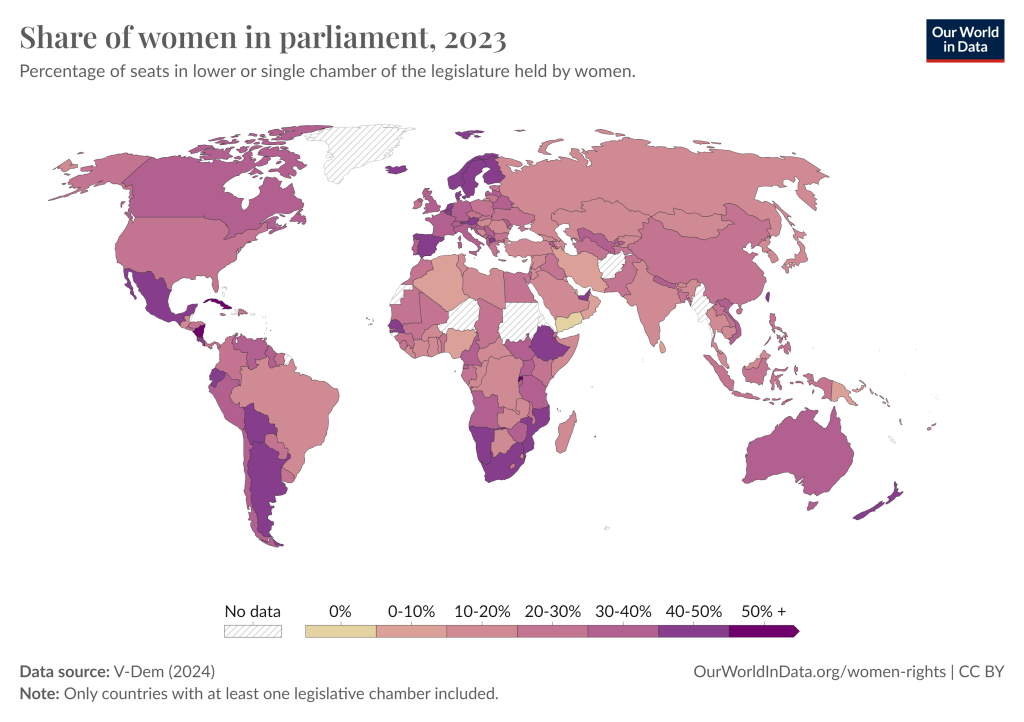
So why is it that not enough women run for office or get elected in Ireland? If we look at the statistics in Europe, Ireland has the 6th lowest rate of female participation in lower houses of parliament, only 26.5% of parliamentarians in single or lower houses are women globally, this has risen from 11% in 1995. There has been a steady rise globally of women in politics visible from the 18th and 19th centuries where women did not have the right to vote or sit in parliaments. According to the United Nations only six countries have 50% or more women in parliament globally, Rwanda have 61%, Cuba have 53%, Nicaragua have 52%, Mexico have 50%, New Zealand have 50% and the United Arab Emirates have 50%. In 2008, Rwanda became the first parliament to have more than 50% women, the first women-majority parliament. The UN also recorded last month that there was 28 countries that had women serve as Heads of State and/or Government. At the current rate it will take 130 years to reach gender equality in the highest positions of power.
In Ireland
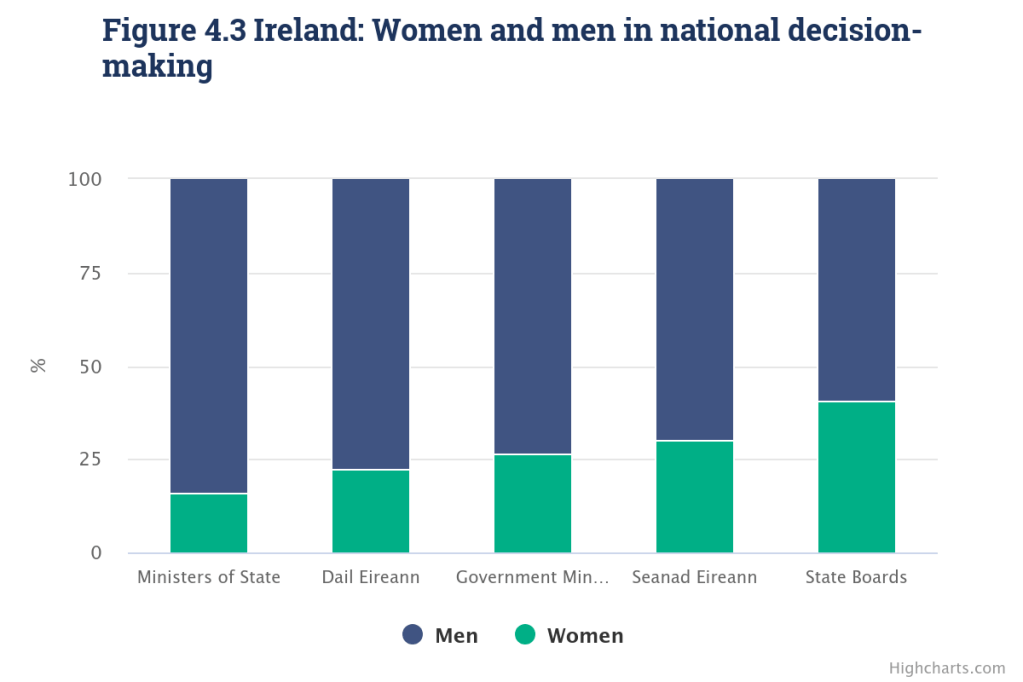
In Ireland, 21.1% of TD’s are women, 38.3% Senators and 25.9% are County Councillors. Barriers exist for women, the “5 Cs”, confidence, childcare, culture, cash and candidate selection are some of the obstacles faced. I recently spoke with a female councillor who sat in a very “traditional Borough” in the North of Ireland. She only ran once as she found it difficult being in a minority, especially when gender sensitive topics arose, she found it “unbearable”. In many cases in our patriarchal system women are still expected to be the main care giver in the home, this limits availability and commitment. We are also resistant to change, traditionally politics has been male dominated and people are reluctant to nominate or vote for someone different. However, voter loyalties to political parties is in decline, elections have become unpredictable. Anti establishment sentiment and positions are contributing to the changing shape of the party system. I believe this will cause more barriers to leveling up women in politics.
Moving Forward
We need to change the dynamic of the political system in Ireland, a change that is reflective of an ever evolving society. Implemented by and includes more women, we need more working-class women, migrant women, Traveler women, rural women, disabled women, more women from the LGBTQI community. Only then will all women be represented here. A 50/50 gender balance in government is key to Ireland becoming a thriving and vibrant society. This quota needs to be met and surpassed. Imagine having a women’s perspective on housing, healthcare or the justice system. How much fairer and more efficient it could be.
There has been a push by various organisations to get more women elected, however, as mentioned by Rachel Coyle, Head of Campaigns and Mobilisation for the National Women’s Council, more women ran in local elections that saw women from diverse backgrounds being elected. However, it still remains that women will only make up around 26 % of Councillors which is the same percentage of outgoing women Councillors.
While a record number of 677 women contested the elections, up from 566 in 2019, it was only 31% of overall candidates. There was an increase in migrant women contesting the elections, however, no Traveller women sought election and in two constituencies, Moate in County Westmeath and An Daingean in County Kerry, no women ran. Local elections are a clear route to national government and both of the two main parties Fianna Fail and Fine Gael failed to meet the 40% quota, failing to even reach 30%. The latest data available in the infographic below compiled by the Central Statistic Office paints a grim picture of women in decision making roles.
In Donegal with thirty-seven seats to fill there was a record nighty one candidates that contested the local elections. Of those elected just three were women from seven electoral areas, one down from the 2019 elections. Joy Beard who ran for the first time was elected on the first count in Buncrana, and Dakota Nic Mheanman was elected in the Lifford-Stranorlar local electoral area. Both Beard and Nic Mheanman are affiliated with the 100% Redress party and Sinn Féin respectively. While Niamh Kennedy retained her seat as an independent candidate in Donegal.
So why is it so important that we encourage more women into politics? Public representation should be diverse, representative of the society we live in. This will benefit all of society promoting a rounded and balanced decision-making process. County Councils implement procedures and make decisions that affect the places where we live, work, and relax whether its affordable housing, road works, environmental issues, providing playgrounds or leisure facilities. Governments make decisions that affect us at a global level. Decisions made by elected representatives affect our everyday life, so it is crucial that women play an equal part in that decision-making process.
Upcoming Women in Local Leadership (WILL) programmein Donegal
Let’s celebrate and support women in leadership together! Join the new Women’s Collective Ireland-Donegal programme starting on Tuesday 17th September 10am-1pm in Donegal Town. This is a FREE 8-week programme for women and a space for you to explore what leadership means and develop your skills and confidence. Over the sessions you will learn about local government structures and voting with a field trip to local government in Lifford and with the opinion to visit Dáil Éireann, look at equality and human rights issues, think critically about lived experiences, gender equality and issues that hold back women’s equality and participation in society. Exploring ways to empower and support those affected by gender discrimination.
If you would like to take part in this programme please fill in our form here https://forms.gle/fUvymoZNasTv8T8n8 and we will be in contact. For more information please email WCI-Donegal on donegal@womenscollective.ie or text us on 085 8638419.
WCI-Donegal are always looking for women to share their stories and looking for women to write features on topics of their choice which we will profile as part of our Women’s Lives, Women’s Voices’ series.






 Women's Collective Donegal