Tag Archive | Eco-Friendly

Why is Circular Dress Collaborative the Talk of the Town?

Sheila Clancy O’Donnell has always believed in the motto “what comes around, goes around.” This belief resonates deeply with her career and the crossroads she finds herself at today. Since she was five years old, she dreamed of a role with the American womenswear brand Liz Claiborne, a dream that came true when she was plucked from college by this icon. Travelling the world, trend shopping on Fifth Avenue in New York City, and dressing millions of American women for decades was a fortunate adventure. Watching her designs progress from sketches to the sales floor was a thrill that was never undervalued.

However, the life of raising children while jetting around the globe for months didn’t blend well. Leaving behind such a cherished career led to a positive turn when she relocated to picturesque Donegal. It was here that her creativity was reignited, inspired by fresh air, a kind community, and the stunning colours that surround her. With a newfound passion for storytelling and nurturing others, Sheila wrote a children’s book and developed a fashion course at both secondary and third levels, celebrating Donegal’s exquisite fabrics and the circular environment they create. Having collaborated in New York on collections that incorporated Donegal tweed, she felt it essential to keep the fabric’s heritage alive.

It was Sheila’s 19-year tenure as a manager for Marks & Spencer, Homestore and More, and TJX Europe that allowed her space to advocate and deliver on these aspirations. Her dedication to sustainable fashion in schools earned her the title of “Face of Corporate and Social Responsibility.” She was also recognised for notable charitable involvement in “Denim vs. Cancer,” a design event organised with her fashion students, and “Friends of the Elderly,” her cherished workmates.

Inspired to contribute further to a sustainable future, Sheila enrolled in an online Master of Science in Sustainability Leadership at the University of Galway in 2023. A field trip to Bologna, Italy, in 2024 sparked the inspiration for Circular Dress Collaborative. Visiting Eta Beta, a social enterprise aiding marginalised individuals through art and agriculture, Sheila realised she could channel her fashion knowledge into a model that could benefit Letterkenny, Donegal, and the environment. Learning about the climate crisis exacerbated by excessive clothing consumption motivated her to act, creating a project that maximises benefits for the community. The first stop was the Donegal Local Development Company (DLDC) in Letterkenny to understand the steps needed to make this social enterprise thrive.

With that help, the Circular Dress Collaborative was born, embodying the principles of “Resale, Repair, Repurpose, Rebuild, and Remember.” Its clothing collection is carefully curated and sourced from women both locally and beyond, ensuring a diverse range from luxury to high-street. When items are sold, the majority of the proceeds go to the women who originally owned them—this being the “Resale” aspect. “Repairs” extend the life of garments, “Repurpose” encourages creativity through arts and crafts, and “Rebuild” involves training volunteers and social welfare recipients in a supportive business setting. Classes teach new skills, which is the “Remember” aspect of this movement. The mission is to keep clothing and fabrics circulating, ensuring that people and opportunities are also not forgotten.

Sheila’s endeavour to empower women who might otherwise feel marginalised was awarded Best Sustainable Practice at the 2024 DLDC Community Recognition Awards, after only three months of opening.

There’s no denying this is an example of a career coming full circle, reconnecting a designer with her passions for fashion and community. Ironically, just a week ago, a customer brought in a handbag to sell—and it was from… Liz Claiborne! Signs like this make Sheila believe “what comes around is meant to go around again.”

The Circular Dress Collaborative is located at Unit 1 Thorn Road, Letterkenny, F92 X8PP (directly next to the Kube Building)

Opening hours: 10.00am – 5.00pm Wednesday – Saturday & 12.00pm – 5.00pm Sunday

Website & Socials

https://circulardresscollaborative.com/

https://www.facebook.com/circulardresscollaborative

https://www.instagram.com/circulardresscollab/

How to Introduce Eco-Friendly Changes

10

This feature is part of the NCCWN Donegal Women’s Network, ‘Women’s Lives, Women’s Voices’ series. Written by Mary Lane to raise awareness to the global movement and campaign ‘Plastic Free July’. This is the first in a two part feature by Mary who reflects on her experience of becoming aware of the concept of Zero Waste and how she has managed to bring a zero waste lifestyle into her family home.


This month, July 2019, we have decided to try Plastic Free July. We knew from the get go that we would never achieve 100% plastic free but we definitely knew we could use it as an incentive to at least make conscious decisions about what plastic we did use, and where we could actually skip it.

It has been a very eye opening experience. Food is definitely a hurdle to get the head around. Shopping at supermarkets has its challenges, especially when it comes to fruits and vegetables. While there are plastic free options, the cost is often more expensive.

Plastic-v-no-plastic

For example, a twin pack of courgettes can be bought pre packed in a plastic tray and wrapper for around 90c for 500g weight. Loose courgettes are €3.29 per kilo, meaning a single courgettes set me back €1.14. Apples and oranges can be bought in a multipack plastic bag for less than a euro, yet the loose ones are 40-60c each, or 5 for €2. A 1kg bag of carrots containing at least a dozen pieces can cost under one euro, yet opting for 4 loose carrots cost over 50c.

On a friend’s suggestion however, I visited a vegetable market that’s less than 5 minutes from my house. I bought a whole stack of food – sweet potatoes, mushrooms, carrots, broccoli, oranges, and a bottle of lemonade in a returnable glass bottle, all for only €6.


Other swaps we have made this month are:

  • Bringing my own containers to the butchers rather than using their plastic bags.

  • Choosing a toothpaste in a recyclable metal tube.

  • I’ve ordered bamboo toothbrushes online, so we will be swapping out our plastic ones. These are fully biodegradable and can just go in the household compost.

  • I bought some glass storage jars to keep my homemade cookies, popcorn and other snacks in.

  • I stopped buying hummus and falafel – foods we love – and I made them myself at home from tinned chickpeas and they were delicious.

  • We often bought a lot of tortilla wraps, but I tried my hand at making an easy alternative – Indian chapatis. While they’re not a direct comparison, they did the job perfectly well and were very tasty. And no nasty extra ingredients!

  • I’ve been taking a stainless steel water bottle everywhere and actually using it! I’d previously been guilty of buying reusable bottles and not using them more than two or three times, and also buying plastic bottles of drinks when out and about. With an exception on one very hot day, I’ve gone without these extra purchases.

  • I picked up a set of stainless steel straws for us to use when out and about so we can skip the plastic ones as much as possible.


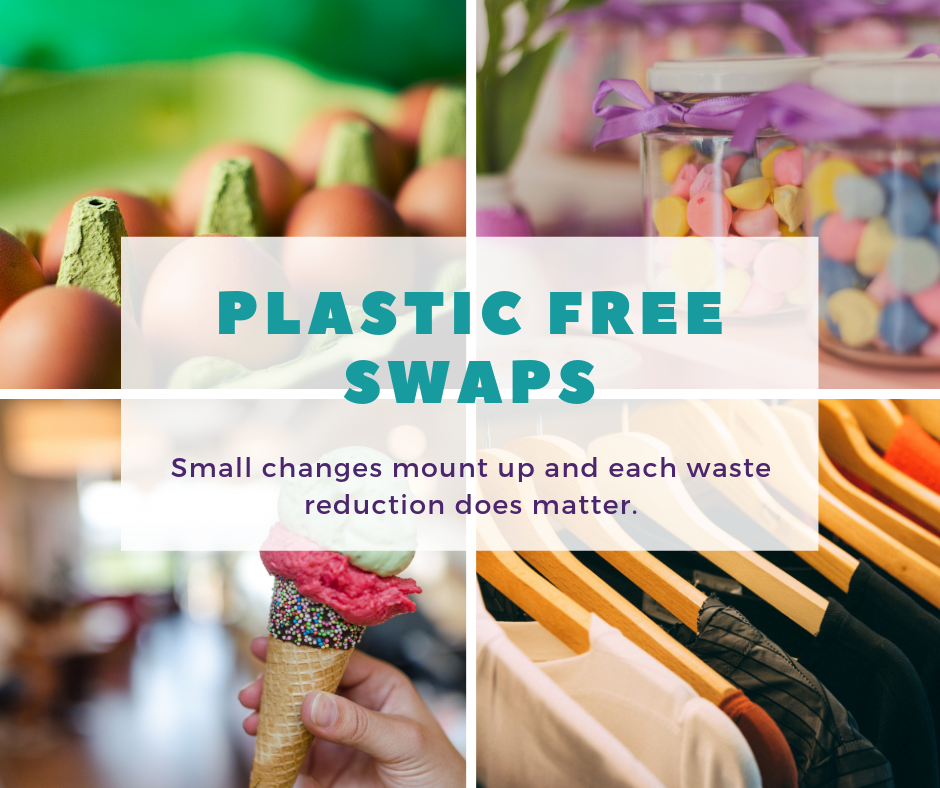
Plastic Free Swaps

 I’ve baked instead of buying biscuits and treats. 

I’ve switched as much as possible to jars, glass bottles and tins. So ketchup, mayonnaise, relish, etc in plastic bottles are all being replaced by glass contained alternatives as they finish. 

We have replaced some of our bread consumption with package free bread from the bakery, or French sticks bought in a paper wrapper. 

I’ve popped our own popcorn for snacks, instead of individual portion bags or crisps. While the kernels come in a plastic bag, the amount of plastic is much smaller than the alternative.

12

 We had been buying eggs in plastic cartons, but have switched to traditional cardboard ones.

We needed new food storage as most of our plastic Tupperware had gone walkies along the way. I chose a set of glass tubs with plastic and silicone lids. Again, not totally plastic free but certainly less plastic. Also, the glass containers can be used to reheat food in the oven and microwave, and don’t pose any risk of leaking harmful BPAs into the food. 

My son loves ice lollies. And many days it almost the only hydration I can get into him. I’ve been making them just with water or juice in a mould at home and he loves them. Where possible, we have chosen ice cream in cones when out and about rather than in tubs or pops in plastic wrappers. 

I’ve brought cloth bags when buying loose fruit, vegetables, baked goods, etc. I made these myself from old T-shirts that were going to be donated.


Realistically, I think that for my family Zero Waste and Plastic Free isn’t achievable, BUT I think we have definitely benefited and will continue to benefit from having these “extreme” concepts to the front of our minds when buying things, or making decisions that might have unnecessary wasteful impacts.


Given that pretty much all plastic products and disposable resources have only been around for the past 60 years or so, and increasing at a disastrous rate over the last couple of decades, it’s really awful to see the impact on our environment and more worryingly is the thought that it is irreversible. But now really is the time to get a handle on it and it does start in each of our homes. Small changes mount up and each waste reduction does matter.


In our home, we are really making changed with the Reduce, Reuse, Recycle mantra, but also adding into it the ideas of repair, rebuild, refurbish, refinish, resell and rot (compost). Anything after that should be restricted, redesigned or removed from production.


We need to be showing our children that consumerism and the need for everything to come in its own wrapper is not actually the best thing for our world, and that disposable is not always good. We need to set examples to our friends, family, co-workers, etc. that introducing small eco-friendly changes are not to be feared or ridiculed.

I’m pretty sure many people just want a “simple life”. Why not start by making life simple?


Plastic Free July is a global movement that helps millions of people be part of the solution to plastic pollution – so we can have cleaner streets, oceans, and beautiful communities. Will you be part of Plastic Free July by choosing to refuse single-use plastics? To find out more about this global movement check out the https://www.plasticfreejuly.org/ website


NCCWN Donegal are always looking for women to share their stories and looking for women to write features on topics of their choice which we will profile as part of our Women’s Lives, Women’s Voices’ series.