Archives

Why are women significantly outnumbered by men in Irish politics?


Women from across Donegal and representing various community groups attending the Donegal County Council’s EMPOWER HER event in Lifford Council Chamber.

This Women’s Lives, Women’s Voice’s feature is written by Rhona Hannigan, Development Worker with the Women’s Collective Ireland-Donegal. Highlighting the issue of the lack of women in local politics and poses the question, why is there still so many male politicians representing women’s voices in all aspects of Irish politics?


With the local and European elections wrapped up its important that we highlight the continued lack of female political representation in Irish Politics. Why should we focus on women’s politics now as the elections are over, well we have a general election coming up before March next year, with the possibility of an early election in autumn. With so many other focus areas like healthcare, migration and housing, gender equality seems to have gone by the way side. Important issues like pay parity, gender based violence and equal pensions for women. Recent research shows that women in Ireland would need to work eight years longer to retire with the same pensions as men. The 2024 Gender Pension Gap Report from Irish Life found that there is a 36% gender pension gap faced by working women, highlighting the inequalities between men and women right the way through to retirement.


A Global Context

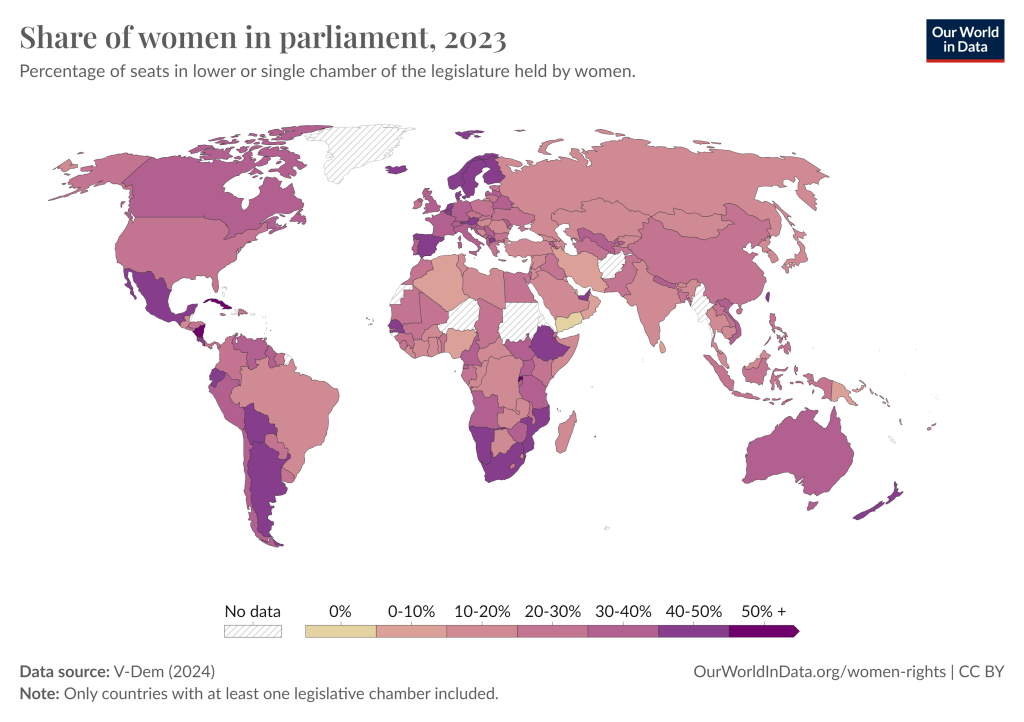
So why is it that not enough women run for office or get elected in Ireland? If we look at the statistics in Europe, Ireland has the 6th lowest rate of female participation in lower houses of parliament, only 26.5% of parliamentarians in single or lower houses are women globally, this has risen from 11% in 1995. There has been a steady rise globally of women in politics visible from the 18th and 19th centuries where women did not have the right to vote or sit in parliaments. According to the United Nations only six countries have 50% or more women in parliament globally, Rwanda have 61%, Cuba have 53%, Nicaragua have 52%, Mexico have 50%, New Zealand have 50% and the United Arab Emirates have 50%.  In 2008, Rwanda became the first parliament to have more than 50% women, the first women-majority parliament. The UN also recorded last month that there was 28 countries that had women serve as Heads of State and/or Government. At the current rate it will take 130 years to reach gender equality in the highest positions of power.

In Ireland

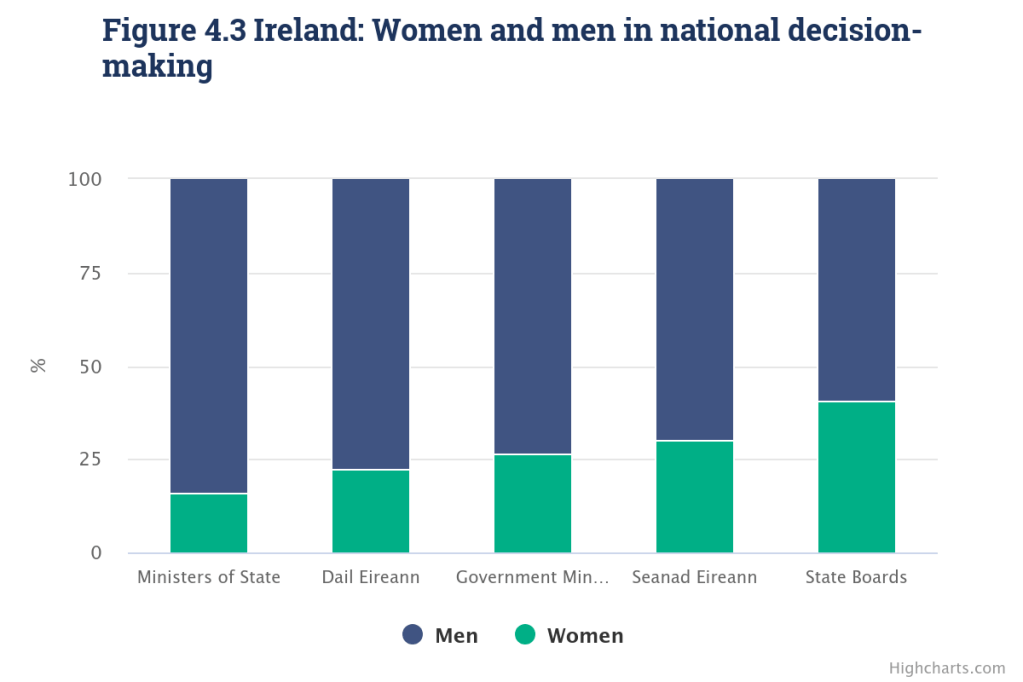
In Ireland, 21.1% of TD’s are women, 38.3% Senators and 25.9% are County Councillors. Barriers exist for women, the “5 Cs”, confidence, childcare, culture, cash and candidate selection are some of the obstacles faced. I recently spoke with a female councillor who sat in a very “traditional Borough” in the North of Ireland. She only ran once as she found it difficult being in a minority, especially when gender sensitive topics arose, she found it “unbearable”. In many cases in our patriarchal system women are still expected to be the main care giver in the home, this limits availability and commitment. We are also resistant to change, traditionally politics has been male dominated and people are reluctant to nominate or vote for someone different. However, voter loyalties to political parties is in decline, elections have become unpredictable. Anti establishment sentiment and positions are contributing to the changing shape of the party system. I believe this will cause more barriers to leveling up women in politics.


Moving Forward

We need to change the dynamic of the political system in Ireland, a change that is reflective of an ever evolving society. Implemented by and includes more women, we need more working-class women, migrant women, Traveler women, rural women, disabled women, more women from the LGBTQI community. Only then will all women be represented here. A 50/50 gender balance in government is key to Ireland becoming a thriving and vibrant society. This quota needs to be met and surpassed. Imagine having a women’s perspective on housing, healthcare or the justice system. How much fairer and more efficient it could be.

There has been a push by various organisations to get more women elected, however, as mentioned by Rachel Coyle, Head of Campaigns and Mobilisation for the National Women’s Council, more women ran in local elections that saw women from diverse backgrounds being elected. However, it still remains that women will only make up around 26 % of Councillors which is the same percentage of outgoing women Councillors.

While a record number of 677 women contested the elections, up from 566 in 2019, it was only 31% of overall candidates. There was an increase in migrant women contesting the elections, however, no Traveller women sought election and in two constituencies, Moate in County Westmeath and An Daingean in County Kerry, no women ran. Local elections are a clear route to national government and both of the two main parties  Fianna Fail and Fine Gael failed to meet the 40% quota, failing to even reach 30%. The latest data available in the infographic below compiled by the Central Statistic Office paints a grim picture of women in decision making roles.

In Donegal with thirty-seven seats to fill there was a record nighty one candidates that contested the local elections. Of those elected just three were women from seven electoral areas, one down from the 2019 elections. Joy Beard who ran for the first time was elected on the first count in Buncrana, and Dakota Nic Mheanman was elected in the Lifford-Stranorlar local electoral area. Both Beard and Nic Mheanman are affiliated with the 100% Redress party and Sinn Féin respectively. While Niamh Kennedy retained her seat as an independent candidate in Donegal. 

So why is it so important that we encourage more women into politics? Public representation should be diverse, representative of the society we live in. This will benefit all of society promoting a rounded and balanced decision-making process. County Councils implement procedures and make decisions that affect the places where we live, work, and relax whether its affordable housing, road works, environmental issues, providing playgrounds or leisure facilities. Governments make decisions that affect us at a global level. Decisions made by elected representatives affect our everyday life, so it is crucial that women play an equal part in that decision-making process.


Upcoming Women in Local Leadership (WILL) programme in Donegal

Let’s celebrate and support women in leadership together! Join the new Women’s Collective Ireland-Donegal programme starting on Tuesday 17th September 10am-1pm in Donegal Town. This is a FREE 8-week programme for women and a space for you to explore what leadership means and develop your skills and confidence. Over the sessions you will learn about local government structures and voting with a field trip to local government in Lifford and with the opinion to visit Dáil Éireann, look at equality and human rights issues, think critically about lived experiences, gender equality and issues that hold back women’s equality and participation in society. Exploring ways to empower and support those affected by gender discrimination.

If you would like to take part in this programme please fill in our form here https://forms.gle/fUvymoZNasTv8T8n8 and we will be in contact. For more information please email WCI-Donegal on donegal@womenscollective.ie or text us on 085 8638419.


WCI-Donegal are always looking for women to share their stories and looking for women to write features on topics of their choice which we will profile as part of our Women’s Lives, Women’s Voices’ series.
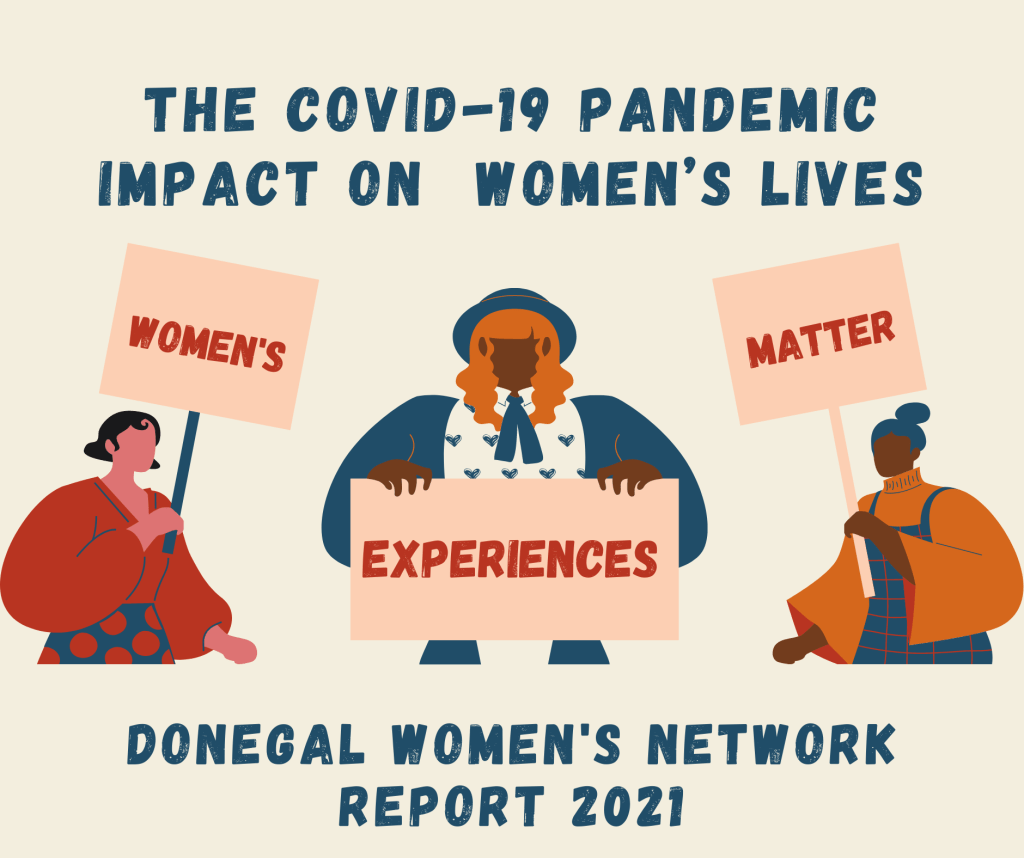
Covid-19 Pandemic: Amplifying Gender Inequality in Donegal

Tuesday 8th March is International Women’s Day, a day to mark the social, economic, cultural and political achievements of women but also draw attention to gender inequality experienced by women.

In 2020, The United Nations  identified women as being one of the most vulnerable groups that are hit hardest by pandemics. With officials suggesting that the coronavirus pandemic could wipe out 25 years of increasing gender equality. “Women are doing significantly more domestic chores and family care, because of the impact of the pandemic. Everything we worked for, that has taken 25 years, could be lost in a year. Employment and education opportunities could be lost, and women may suffer from poorer mental and physical health. The care burden poses a “real risk of reverting to 1950s gender stereotypes”, UN Women Deputy Executive Director Anita Bhatia stated [1] 

As a grassroots women’s organisation NCCWN Donegal Women’s Network also recognised early that women in Donegal would face unique experiences, challenges and impacts during the pandemic because of their gender. We believed it was important women in Donegal had their lived experiences through the pandemic documented, recognised and acknowledged. And that women’s experiences and voices are acknowledged within any local and national post Covid-19 recovery strategy and that decision-making bodies recognise the particular experiences of women’s lives in society and tailor any recovery budgets, policies, plans and programmes accordingly.

For the past two year the Donegal Women’s network have collected data on how the pandemic has impacted women’s lives and gender equality. In 2020 we carried out a county wide survey with 832 women taking part, and in 2021 we carried out a follow up survey with 509 women. It is evident from the data gathered over these two years that the pandemic has created additional stresses for women in the Donegal and added pressure to existing gender inequalities and gender stereotypes.

The women who took part in the surveys talked about a number of issues and challenges they have faced since the start of the pandemic. Such as dealing with additional household workload, increased caring responsibilities, going through pregnancy during the pandemic, and dealing with health challenges. Many of these women talked about the additional workload and the challenge of balancing working from home and childcare, expectations. Home-schooling was a particular issue raised by women, many stated that they had experienced an assumption by their partner that it would be them who would look after home-schooling. Which was a cause of frustration for women.


Changes to Domestic Life

61.4% of women stated that they had seen an increase in physical household workload (such as cooking, cleaning etc.). 41.8% had seen an increase in household admin workload (such as managing bills, appointments etc.). And 50.3% experienced an increase in supporting a family/community member who had to Cocoon due to the pandemic. 38% of women surveyed said that they had seen an increase in adult care responsibilities and compared 46.3% stated that they had experienced an increase in child care responsibilities.

The level of experiences in increased responsibilities varied among women depending on women’s age, civil and household status. Women in the 26-40 years’ category reported the highest level of increased child care responsibilities for any age group; while married women reported the highest level in the civil status category which are both consistent with the 2020 findings. Within the household category, women living with their partner and child/children and lone parent mothers reported the highest experienced increase in child care responsibilities. 

Women in the 18-25 years, followed by 26-40 years’ category reported the highest level in Increased physical household workload; while women under Other, living with partner reported the highest level in the civil status category; within the household category, women living with partner and child/children and women living with a parent/s reported the highest experienced increase in physical household workload.

Women in the 18-25 years’ category (63%) reported the highest level in supporting a family/community member cocooning for any age group, again this is consistent with the 2020 findings although there was a reported 9% experienced increase within this age group.  

Widowed women (75%) reported the highest level in the civil status category; within the household category, women with other house status (75%) and women living with my parent/s (66.7%) reported the highest level in supporting a family/community member cocooning.

Mental Health Impacts

Women reported an overwhelming increase in the impact of the pandemic on their mental health. When asked how would you describe how your mental health has been impacted by the pandemic? 55.8% of women said moderately and a further 24% said it had extremely been impacted. This is an increase from June 2020 when 61.1% felt their mental health had been impacted by the pandemic.

These percentage figures saw an increase for women depending on their age, women in the 18-25 age group reported the highest impact with 47.3% stating that their mental health had been moderately impacted and a further 42.1% stating extremely impacted. Women in the 26-40 age group came second with 55.1% stating that their mental health had been moderately impacted and a further 30.8% stating extremely impacted. 

Women in the Carndonagh Local Electoral Area reported the highest level of mental health impact with 59.4% stating that their mental health had been moderately impacted and a further 29.7% stating extremely impacted. Buncrana followed behind with 55.6% stating that their mental health had been moderately impacted and a further 28.9% stating extremely impacted.

Women with a civil status of living with a partner had the highest percentage for any civil status category. With 59.6% stating that their mental health had been moderately impacted and a further 29.8% stating extremely impacted. Separated/divorced women came second with 53.7% stating that their mental health had been moderately impacted and a further 31.4% stating extremely impacted.  

Women with a household status of living with a parent/s had the highest percentage for any household status category, with 48.4% stating that their mental health had been moderately impacted and a further 39.3% stating extremely impacted.

The amount of time women had to look after their mental health has also been impacted, with 42% of women stating they now had less time to time.

51.2% of women within the 26-40 years’ age group, stated that they had less time to look after their mental health and wellbeing, the highest rate of all the age groups. 55.3% of women with a civil status of living with a partner reported the highest rate within the civil status group. 

And 53.2% of women with a household status of living with a partner and child stated that they had less time to look after their mental health and wellbeing, the highest rate of all the household status groups. 

Feelings of isolation and loneliness has been a particular area of mental health experienced by women with 75.4% of women reporting that they have experienced feelings of isolation, a sharp increase from the 60.4% reported in 2020. While 70.7% of women reported feelings of loneliness since the pandemic, again an increase from the 57% reported in 2020.


Paid work and employment challenges

43.2% of the women surveyed said that their job became classified as a frontline worker or essential worker. 31.8% of women were now working from home. 17.9% saw their job working hours reduced as a result of the pandemic. 12% experienced a job loss as a consequence. 14% received the Covid-19 Pandemic Unemployment Payment. While 4.7% of surveyed women reported a job loss/suspension due to caring responsibilities.

Additional childcare responsibilities during the pandemic has impacted women’s paid work and employment greatly. When further asked whether they felt their employer was supportive in understanding how the pandemic has impacted these responsibilities, of those women the question directly applied to 28% of those women answered NO, an increase from the 24% result in June 2020.

When asked why they felt that their employer has not been supportive, a number of women gave examples of their experiences including, their employer not being flexible with childcare responsibilities, being forced to use annual leave for childcare, with essential workers with children finding it particularly challenging with employers.


The data further highlights that women have come to learn, develop, be resilient and adapt to living through the pandemic. Some women have experienced opportunities to develop and be innovative i.e. engaging in online learning and using technology for social and community engagement, which has allowed them to engage in new opportunities they may not have been able to in the past, due to travel distances or caring responsibilities.

And while women have reported adapting to living with the pandemic, a question that must be asked is at what cost to their long-term mental health? Is this adaptation and change sustainable in the long term or even fair? And is there significant capacity within mental health support services locally to meet future demand?

The experiences of women also highlight that there needs to be a better understanding about gender inequality and its impact on women’s lives. With the majority of childcare responsibilities falling onto the women within households, there seems to be assumptions it will be the woman who is solely responsible for this area of work. While there may be situations where this is agreed upon, the vast majority of the experiences expressed by women would indicate that there is often no agreement within relationships but rather an assumption.

Such assumptions are likely built by continued held social gender stereotypes, that a woman’s role is to look after the children and family home. Such stereotypes are detrimental to achieving gender equality and the healthy sustainable development of our society.

You can download a full copy of the 2021 follow up impact survey report with recommendations below here.


NCCWN Donegal Women’s Network would like to thank and acknowledge all the women who took the time to complete our county Covid-19 Impact Survey. Your time and insightful input are very much appreciated. Your shared experiences help inform our work over the coming year, as we will continue to support women throughout and beyond this pandemic.

If you would like to know further information about NCCWN Donegal Women’s Network and our work please visit donegalwomensnetwork.org or email us on donegal@womenscollective.ie


[1] Coronavirus and gender: More chores for women set back gains in equality; By Sandrine Lungumbu and Amelia Butterly,  November 2020

Do you know about the COVID-19 Restrictions in Maternity Services?

Maternity services in Ireland should matter, please get involved and show your support.


NCCWN Donegal Women’s Network as a project of The National Collective of Community based Women’s Networks (NCCWN) are calling on the Government to ease COVID-19 restrictions in maternity services and allow birthing partners to support pregnant people and be present at all pregnancy related appointments, scans, full labour and birth as soon as possible.

As part of this call, we are also asking members of the public to let Government representatives know that you are not happy with the current measures or treatment of pregnant people and you want restrictions in maternity services to ease.

To make it as easy as possible for you to contact your local TD we have drafted a letter you can use to express your concerns and support every pregnant person across the country. You can find who your local TD is and how they can be contacted at: https://www.whoismytd.com/.

If you are part of a women’s group and would like to draft your own letter, please feel free to contact your nearest NCCWN project for support. You can find where all of our projects are located here. Or, if you would like your nearest project to send the letter on your behalf please contact us and let us know. Your personal details will only be used for this campaign unless you indicate that you want us to retain your details.

Download the letter template

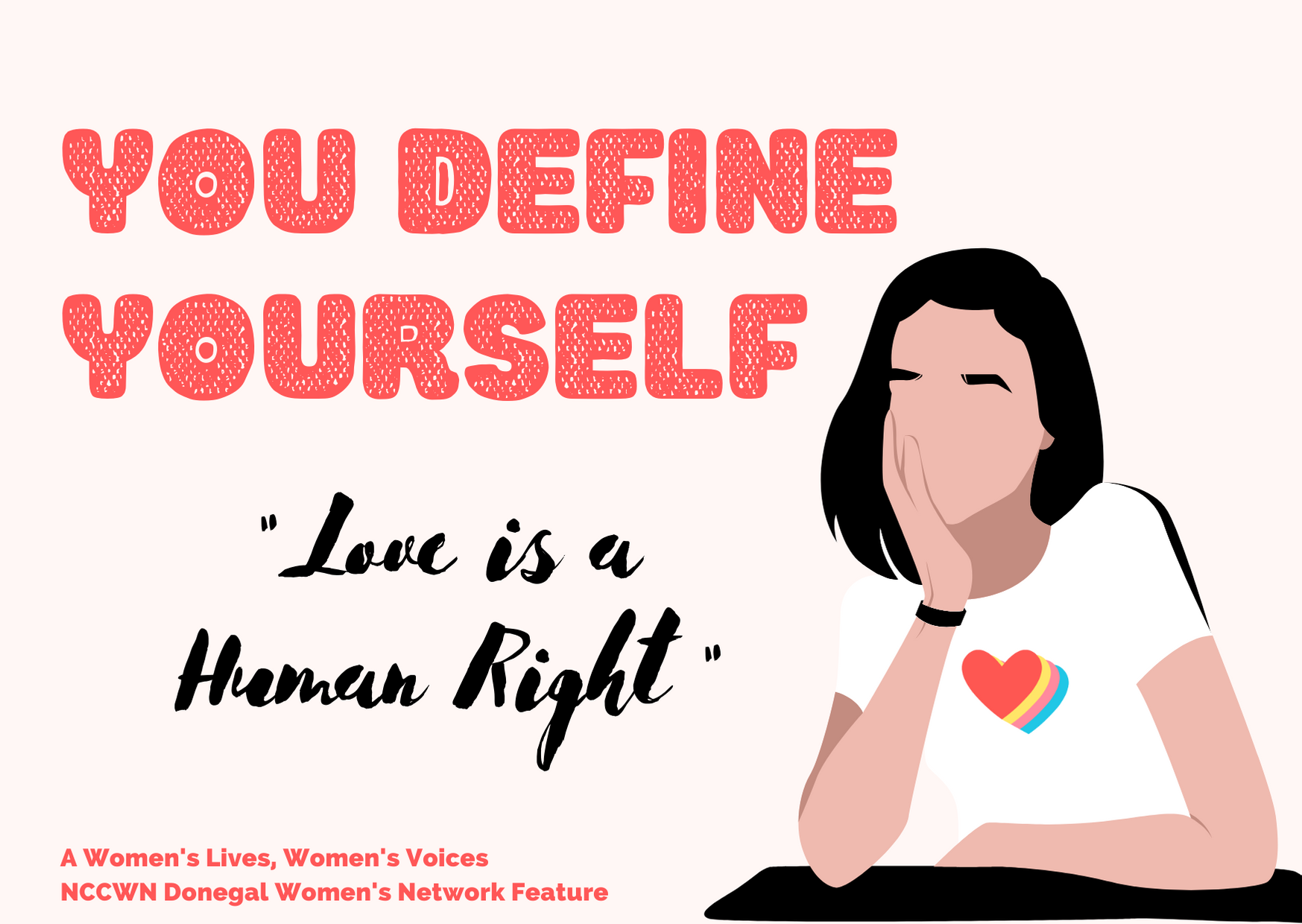
You Define Yourself

Khaki Old Couple Illustration Valentine's Day Card (1)

On Sunday 26th April 2020, Ireland joined others around the world to celebrate the 11th Lesbian Visibility Day, a day to celebrate, recognise, and bring visibility to lesbians. To honour this day local community group Donegal LGBTQ+ shared the story of Ann Marie which outlined the struggle of accepting one’s own sexual identity. In this Women’s Lives, Women’s Voices’ feature with the permission of Ann Marie we share her journey of loss, of love and the battle to belong.


Hi all, my name is Ann Marie or aka Annie. This is the normal way I introduce myself because that is who I am. When people ask me what I do, I say I work as an accounts administrator and I coach football and camogie and tutor part time.


Again, this is what I do but that’s not all is it? It’s that nagging voice in your head telling you to blurt out that you’re a lesbian shout it out get it out there but I don’t and not because I am ashamed but because it shouldn’t matter. It doesn’t define my decisions in life it doesn’t make me a better or worse person. If I make a big deal of been a lesbian then its making it out to be a big deal and it’s not. I am who I am and the ups and downs of life make me who I am not who I love.


When I was in my teens I always felt a little different to other girls my age. Boys weren’t the big concern in my life. One of my best friend set me up with her neighbour. We went out for a bit but lasted a month or so. I had to pretend to be upset that we broke up but I wasn’t. I couldn’t understand why I didn’t feel upset though he was a nice guy, cute and treated me well. Then one day everything changed not because I dramatically fell in love with a girl but because of a TV show called Playing the Field. I was extremely sporty playing camogie, soccer and basketball (I started playing Gaelic football late in life).

This show was about women playing soccer and the drama that goes with it. I loved it and there was two characters who started getting close to each other and they happened to be two women. I became obsessed with them but in my head, it was just because they played soccer. Reflecting back these characters opened up my eyes. It was late 90s and I had never seen two women together before. I would safely say I was very naive. So, I starting looking for shows that would have lesbian content, fortunately for me it was a time of change in the world and TV shows were starting to introduce gay characters for me Bad Girls and Buffy became my new favourite shows. The only problem was I was in a relationship with a guy.


Expectation is hard to deal with but when the expectation is coming from yourself it’s a whole lot worse. I always wanted to be the best and I took negativity and criticism really bad. I wanted to be the best daughter, best granddaughter I wanted to be someone that my parents would be proud to introduce to friends. I wanted mam to be able to show off her daughter and show how well she brought me up and for me this was the hardest part of been gay. I didn’t want mam to have to introduce her gay daughter to anyone. So, I kept it a secret I became an actor in my own right, said the right things at the right time did the right things and even talked about marriage. Then one day I met someone that would change my life for ever in good ways and bad. I fell in love but I was still in a relationship with a man. I would talk for hours with her about my feelings, about my fears and about my lies that I had to tell. She was amazing she listened she gave me advice and we fell in love. The thing was, as we look back on it, how we fell in love more or less instantly. So, after my grandfather died I made a promise that I would do the right thing. I would finish my relationship and start preparing myself to talk to my parents.


What I haven’t mentioned yet is that the woman I fell in love with lived a in a different country thousand miles away. She travelled over to meet with me for the first time and it was amazing. Everything felt right. Holding her hand, looking into her eyes everything just felt the way you read in books but that nagging voice in the back of my head was telling me to run. Anxiety hit, fear of telling my mam and dad doubled this shit was real now. Before I could pretend it didn’t exist but now I couldn’t. I would stay up long into the night going over how I would tell them. Every time I would build up the courage something stopped me from doing it. I hated myself, I hated looking in the mirror I couldn’t look at myself in the eye. I starting retreating into my room secretly drinking to help me sleep. I was 26. I spent nearly 10 years with a secret that was slowly killing me inside. So, what happened next well my biggest regret happened next I was so consumed with how I was feeling that my relationship with the woman I loved got destroyed. Not going into the details as that is another story to be told.


My mum was having a birthday the big 50 and I managed to ruin it by coming out as I was not able to hold it in any longer. It just came rushing out the week before her surprise birthday party and I gave the poor woman no chance to deal with it. I didn’t tell her in a controlled way I was totally uncontrollable at that point. She didn’t take it well but not for been gay I don’t think but probably more about the way I done it. My mum and dad are amazing people. It took them time to deal with it but who am I to judge it took me 10 years. They are my biggest allies and voted yes in the referendum and are proud to introduce me. Mam says “how could I not be proud of you look at you, look at who you have become”


So where am I now, I now live in Donegal (from Kilkenny) and I am back with my first love and smashing the long-distance thing. Advice for those coming out be relaxed be calm be proud of who you are, been part of the LGBTQ+ community is just something your part of it doesn’t define you. You define yourself.


I am Ann Marie. The person I was meant to be and the person I will be in the future.


NCCWN Donegal Women’s Network would like to thank Donegal LGBTQ+ and Ann Marie for sharing with us an insightful lived experience.

Donegal LGBTQ+ aims to promote the health and wellbeing of LGBTQ+ people and increase the social connectiveness across the county by providing information and supports as well as offering events with local partnerships. They are a non-profit community and you can find them on facebook here by email at donegallgbt@gmail.com or phone number 086 088 7738.

donegal lqbt logo


NCCWN Donegal are always looking for women to share their stories and looking for women to write features on topics of their choice which we will profile as part of our Women’s Lives, Women’s Voices’ series.