Archives

Covid-19 Pandemic: Amplifying Gender Inequality in Donegal

Tuesday 8th March is International Women’s Day, a day to mark the social, economic, cultural and political achievements of women but also draw attention to gender inequality experienced by women.

In 2020, The United Nations  identified women as being one of the most vulnerable groups that are hit hardest by pandemics. With officials suggesting that the coronavirus pandemic could wipe out 25 years of increasing gender equality. “Women are doing significantly more domestic chores and family care, because of the impact of the pandemic. Everything we worked for, that has taken 25 years, could be lost in a year. Employment and education opportunities could be lost, and women may suffer from poorer mental and physical health. The care burden poses a “real risk of reverting to 1950s gender stereotypes”, UN Women Deputy Executive Director Anita Bhatia stated [1] 

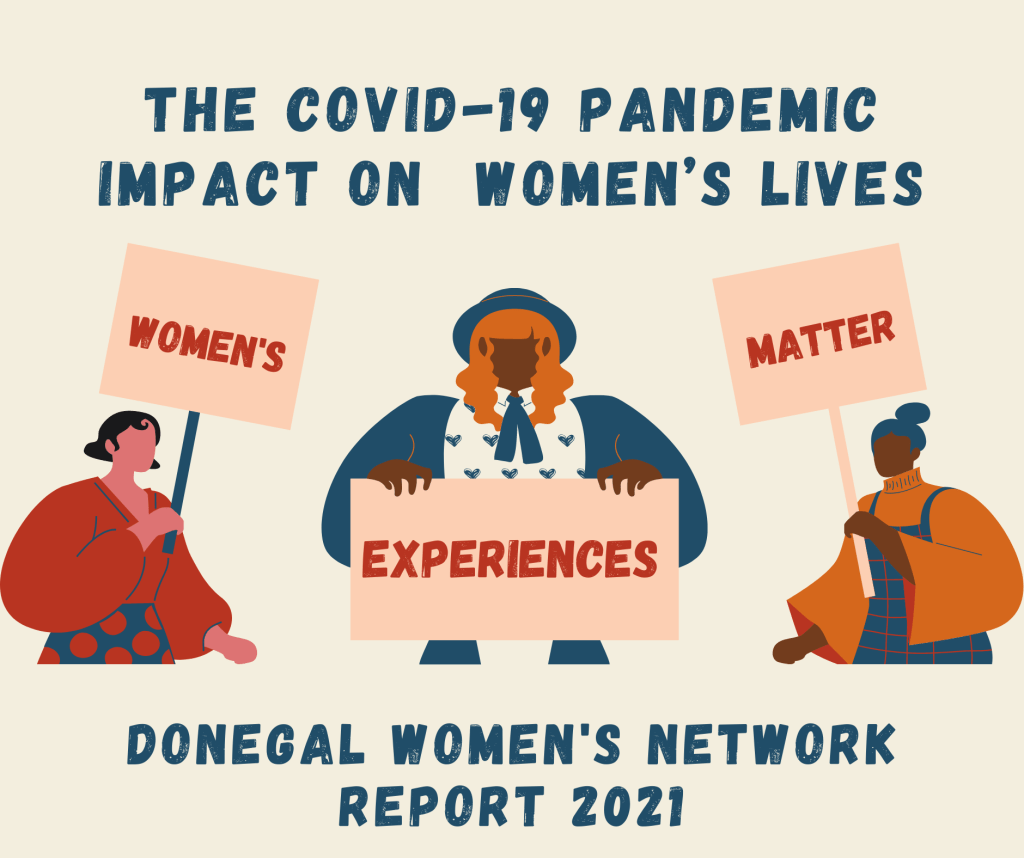
As a grassroots women’s organisation NCCWN Donegal Women’s Network also recognised early that women in Donegal would face unique experiences, challenges and impacts during the pandemic because of their gender. We believed it was important women in Donegal had their lived experiences through the pandemic documented, recognised and acknowledged. And that women’s experiences and voices are acknowledged within any local and national post Covid-19 recovery strategy and that decision-making bodies recognise the particular experiences of women’s lives in society and tailor any recovery budgets, policies, plans and programmes accordingly.

For the past two year the Donegal Women’s network have collected data on how the pandemic has impacted women’s lives and gender equality. In 2020 we carried out a county wide survey with 832 women taking part, and in 2021 we carried out a follow up survey with 509 women. It is evident from the data gathered over these two years that the pandemic has created additional stresses for women in the Donegal and added pressure to existing gender inequalities and gender stereotypes.

The women who took part in the surveys talked about a number of issues and challenges they have faced since the start of the pandemic. Such as dealing with additional household workload, increased caring responsibilities, going through pregnancy during the pandemic, and dealing with health challenges. Many of these women talked about the additional workload and the challenge of balancing working from home and childcare, expectations. Home-schooling was a particular issue raised by women, many stated that they had experienced an assumption by their partner that it would be them who would look after home-schooling. Which was a cause of frustration for women.


Changes to Domestic Life

61.4% of women stated that they had seen an increase in physical household workload (such as cooking, cleaning etc.). 41.8% had seen an increase in household admin workload (such as managing bills, appointments etc.). And 50.3% experienced an increase in supporting a family/community member who had to Cocoon due to the pandemic. 38% of women surveyed said that they had seen an increase in adult care responsibilities and compared 46.3% stated that they had experienced an increase in child care responsibilities.

The level of experiences in increased responsibilities varied among women depending on women’s age, civil and household status. Women in the 26-40 years’ category reported the highest level of increased child care responsibilities for any age group; while married women reported the highest level in the civil status category which are both consistent with the 2020 findings. Within the household category, women living with their partner and child/children and lone parent mothers reported the highest experienced increase in child care responsibilities. 

Women in the 18-25 years, followed by 26-40 years’ category reported the highest level in Increased physical household workload; while women under Other, living with partner reported the highest level in the civil status category; within the household category, women living with partner and child/children and women living with a parent/s reported the highest experienced increase in physical household workload.

Women in the 18-25 years’ category (63%) reported the highest level in supporting a family/community member cocooning for any age group, again this is consistent with the 2020 findings although there was a reported 9% experienced increase within this age group.  

Widowed women (75%) reported the highest level in the civil status category; within the household category, women with other house status (75%) and women living with my parent/s (66.7%) reported the highest level in supporting a family/community member cocooning.

Mental Health Impacts

Women reported an overwhelming increase in the impact of the pandemic on their mental health. When asked how would you describe how your mental health has been impacted by the pandemic? 55.8% of women said moderately and a further 24% said it had extremely been impacted. This is an increase from June 2020 when 61.1% felt their mental health had been impacted by the pandemic.

These percentage figures saw an increase for women depending on their age, women in the 18-25 age group reported the highest impact with 47.3% stating that their mental health had been moderately impacted and a further 42.1% stating extremely impacted. Women in the 26-40 age group came second with 55.1% stating that their mental health had been moderately impacted and a further 30.8% stating extremely impacted. 

Women in the Carndonagh Local Electoral Area reported the highest level of mental health impact with 59.4% stating that their mental health had been moderately impacted and a further 29.7% stating extremely impacted. Buncrana followed behind with 55.6% stating that their mental health had been moderately impacted and a further 28.9% stating extremely impacted.

Women with a civil status of living with a partner had the highest percentage for any civil status category. With 59.6% stating that their mental health had been moderately impacted and a further 29.8% stating extremely impacted. Separated/divorced women came second with 53.7% stating that their mental health had been moderately impacted and a further 31.4% stating extremely impacted.  

Women with a household status of living with a parent/s had the highest percentage for any household status category, with 48.4% stating that their mental health had been moderately impacted and a further 39.3% stating extremely impacted.

The amount of time women had to look after their mental health has also been impacted, with 42% of women stating they now had less time to time.

51.2% of women within the 26-40 years’ age group, stated that they had less time to look after their mental health and wellbeing, the highest rate of all the age groups. 55.3% of women with a civil status of living with a partner reported the highest rate within the civil status group. 

And 53.2% of women with a household status of living with a partner and child stated that they had less time to look after their mental health and wellbeing, the highest rate of all the household status groups. 

Feelings of isolation and loneliness has been a particular area of mental health experienced by women with 75.4% of women reporting that they have experienced feelings of isolation, a sharp increase from the 60.4% reported in 2020. While 70.7% of women reported feelings of loneliness since the pandemic, again an increase from the 57% reported in 2020.


Paid work and employment challenges

43.2% of the women surveyed said that their job became classified as a frontline worker or essential worker. 31.8% of women were now working from home. 17.9% saw their job working hours reduced as a result of the pandemic. 12% experienced a job loss as a consequence. 14% received the Covid-19 Pandemic Unemployment Payment. While 4.7% of surveyed women reported a job loss/suspension due to caring responsibilities.

Additional childcare responsibilities during the pandemic has impacted women’s paid work and employment greatly. When further asked whether they felt their employer was supportive in understanding how the pandemic has impacted these responsibilities, of those women the question directly applied to 28% of those women answered NO, an increase from the 24% result in June 2020.

When asked why they felt that their employer has not been supportive, a number of women gave examples of their experiences including, their employer not being flexible with childcare responsibilities, being forced to use annual leave for childcare, with essential workers with children finding it particularly challenging with employers.


The data further highlights that women have come to learn, develop, be resilient and adapt to living through the pandemic. Some women have experienced opportunities to develop and be innovative i.e. engaging in online learning and using technology for social and community engagement, which has allowed them to engage in new opportunities they may not have been able to in the past, due to travel distances or caring responsibilities.

And while women have reported adapting to living with the pandemic, a question that must be asked is at what cost to their long-term mental health? Is this adaptation and change sustainable in the long term or even fair? And is there significant capacity within mental health support services locally to meet future demand?

The experiences of women also highlight that there needs to be a better understanding about gender inequality and its impact on women’s lives. With the majority of childcare responsibilities falling onto the women within households, there seems to be assumptions it will be the woman who is solely responsible for this area of work. While there may be situations where this is agreed upon, the vast majority of the experiences expressed by women would indicate that there is often no agreement within relationships but rather an assumption.

Such assumptions are likely built by continued held social gender stereotypes, that a woman’s role is to look after the children and family home. Such stereotypes are detrimental to achieving gender equality and the healthy sustainable development of our society.

You can download a full copy of the 2021 follow up impact survey report with recommendations below here.


NCCWN Donegal Women’s Network would like to thank and acknowledge all the women who took the time to complete our county Covid-19 Impact Survey. Your time and insightful input are very much appreciated. Your shared experiences help inform our work over the coming year, as we will continue to support women throughout and beyond this pandemic.

If you would like to know further information about NCCWN Donegal Women’s Network and our work please visit donegalwomensnetwork.org or email us on donegal@womenscollective.ie


[1] Coronavirus and gender: More chores for women set back gains in equality; By Sandrine Lungumbu and Amelia Butterly,  November 2020

Big Community Clean Up

Screenshot_20190619-111322

Women around the world are increasingly becoming recognised as agents of change in supporting climate action and environmental work. Over the years, we have met many inspiring women in Donegal leading the charge in supporting environmental issues. In our latest ‘women’s lives, women’s voices’ feature, Donegal Town local Geraldine McBrearty shares with us her journey to setting up the “Big Community Clean Up” group in Donegal and talks about why it’s so important to keep trying to make an environmental difference.


Hi Everyone, thank you for taking the time to read this article.  In 2016, I founded a small Facebook group called “Big Community Clean Up“.  Its aim was to rally my friends and neighbours to get out for a few hours for the summer months and clean up our beautiful area as much as we could.


What inspired me to do this? Well it was a combination of the older generation and also my children who both always inspire me in all aspects of my life. During one of my walks to my local beach at Drumbeg, I noticed two wonderful ladies in their 60’s walking towards me. I had the pleasure of knowing these ladies many years previously whilst working in Magee of Donegal and I loved meeting them out and about.


To my shock, they were laden down with plastic bottles, old rope, part of an old mud flap and a discarded bicycle rim to name but a few.  They were halfway across the beach and literally could not carry another item.  They stopped to chat with me and I offered to carry what I could for them.  They informed me that they regularly picked up rubbish on the beach. What legends!!


I was gutted that these two amazing ladies had to go to such lengths to clean up our area. Equally worrying was the danger posed to my children from discarded rubbish and broken bottles. They would often ask “Mum, why is it so dirty here”.  It broke my heart.  I decided to organise a few close friends and neighbours to help me out on regular clean-ups.


It was hard work especially as high tides and storms would wash in huge amounts of rubbish onto the shore.  One such beach we cleaned, Matthews Strand, had to be tackled in an almost military manner.  We all had to line up and inch slowly along the beach picking up the endless waste that lay there.  By the end of the few hours cleaning we had made a noticeable difference, everyone was so proud of themselves. The amount of rubbish lifted was so vast that we had to call in the help of the local fishing company MOWI to help us take the rubbish to a designated lifting area for the council to remove.  Just imagine that!

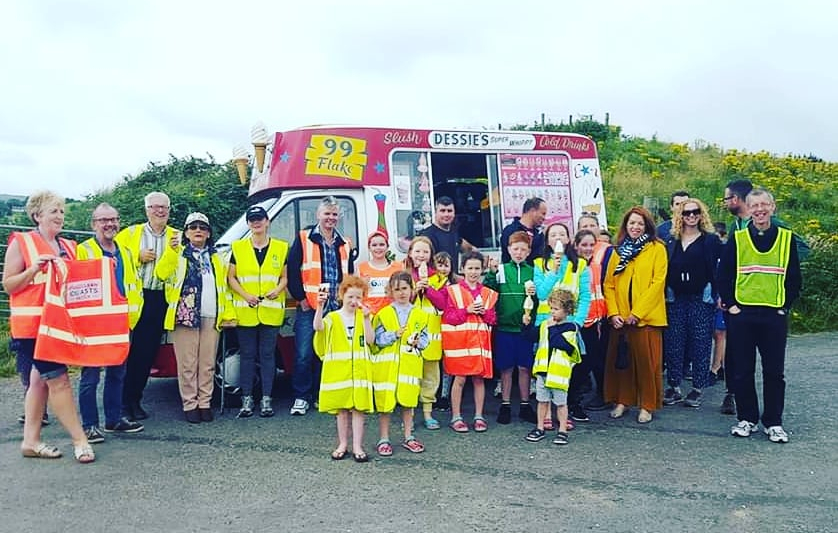
I try to make outings fun, especially for the little children, so I organised on a couple of occasions for an ice cream van to pull up after the clean-up and gave an ice cream to everyone.  It was the least that they all deserved. This was very kindly paid for by the generosity of MOWI and also local councillor Noel Jordan who are always on hand to lend support to the group.


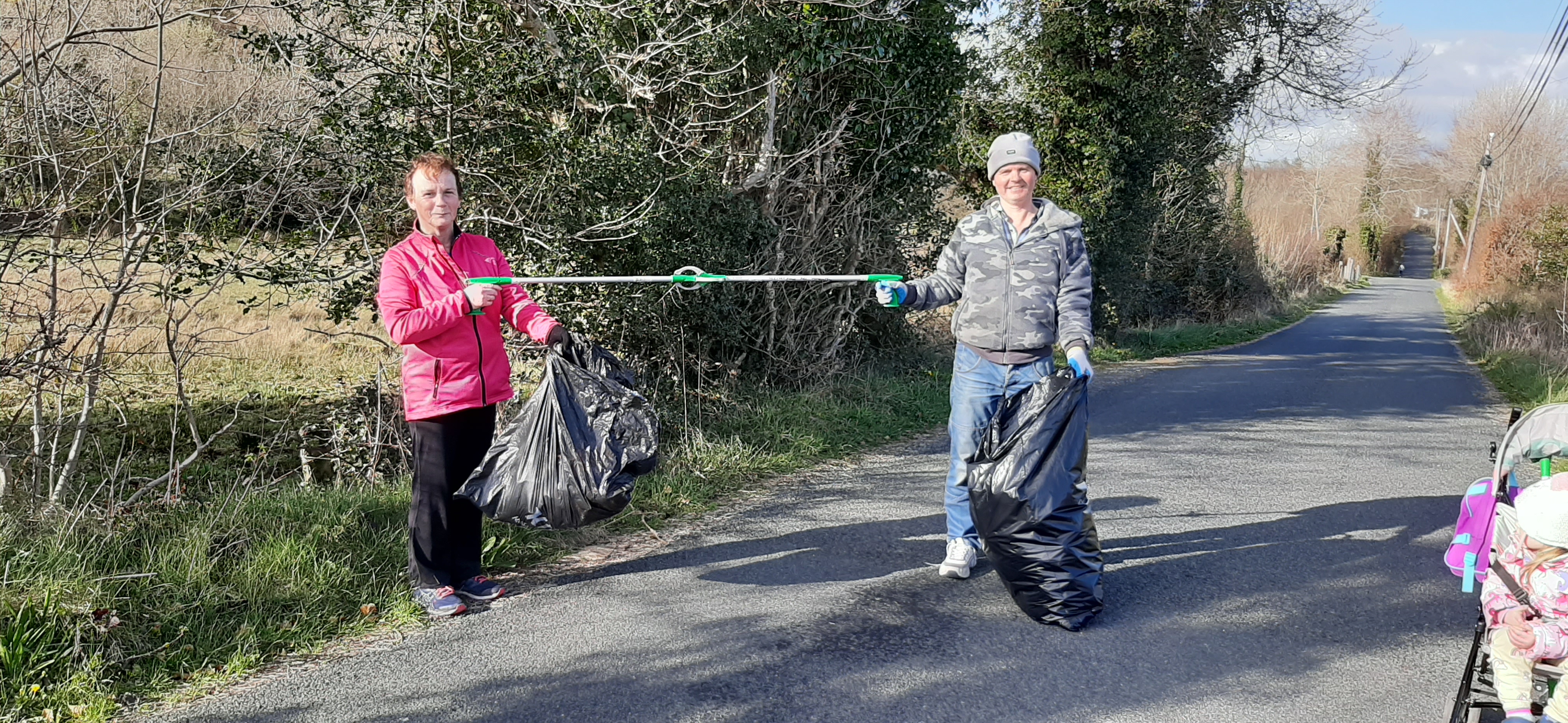
During the Covid-19 pandemic our main supporters, Clean Coasts, have been unable to organise clean-ups around the country due to travel and group restrictions.  However, I decided a few weeks ago to approach my group members to see if we could at least get out with our family members within the 2km area and clean as much as we could.  It worked out fantastically and a lot of rubbish along the roadside and in the ditches, was cleared up before it was covered by the growing grass of Spring.

20200406_173640

A socially distanced clean up

Our next mission is to get onto the beaches for a much needed clean up and to implement social distancing and some safety measures.  It’s so important to keep trying to make a difference.  The council and local litter warden are so helpful and I appreciate their regular support.  I believe that any effort at all is so worth it and will make a difference if we can all get out and make it a part of our daily lives to pick up the rubbish.


Our future

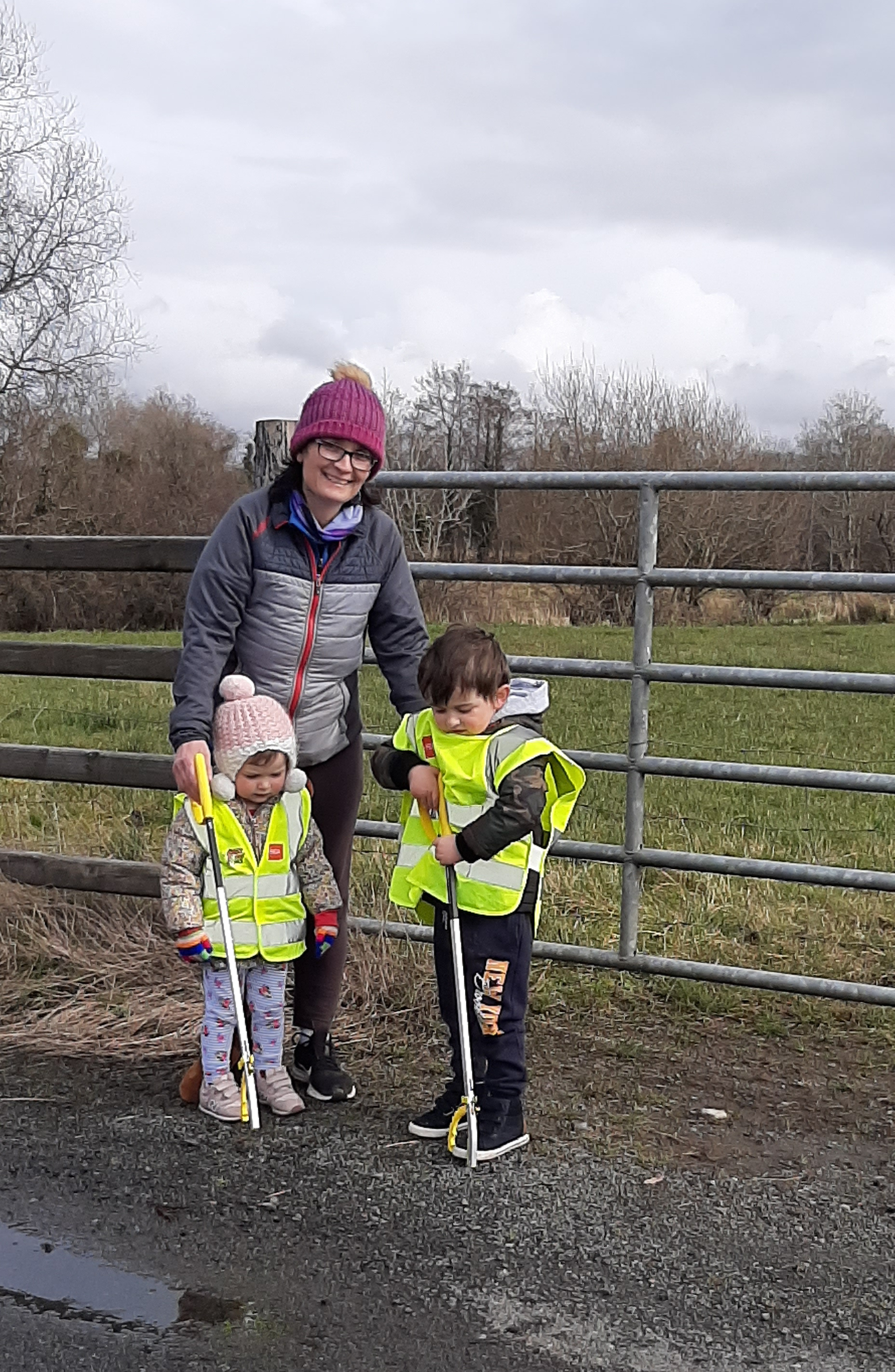
Maria Murphy and her grandkids out and about cleaning up the area around their home on our recent clean up.

The effort we put in today will benefit our children and relatives in the future. What really stands out for me is that there are so many people like my older friends who are out selflessly lifting other people’s rubbish.  We can join them and it makes the burden they are under a little lighter.  That is why I try and get out when I can to lift rubbish.  Thanks so much to everyone in the community who helps out.  It is very much appreciated and every little helps.  Thank you.


To date the group has been a great way to rally people together and to showcase the difference a clean-up makes. People can ask to join the bigcommunitycleanup group or contact their local council who will supply pickers and bags for their own clean ups. Moving forward I’d love to get the beaches cleaned up for the summer but we will have to navigate the social distancing restrictions. Even if each family clean up their own areas and beaches it would make a massive difference.


NCCWN Donegal are always looking for women to share their stories and looking for women to write features on topics of their choice which we will profile as part of our Women’s Lives, Women’s Voices’ series.

Compassionate Women Group Course

Network Compassionate Women

“Women, tend to spend a lot of time caring for others and often forget to extend that same care and love to themselves. Self-compassion is giving ourselves the same kindness, care, and understanding that we offer to others. Developing self-compassion can give us an emotional resilience that leaves us better able to deal with life’s challenges.”

Sara Anderson


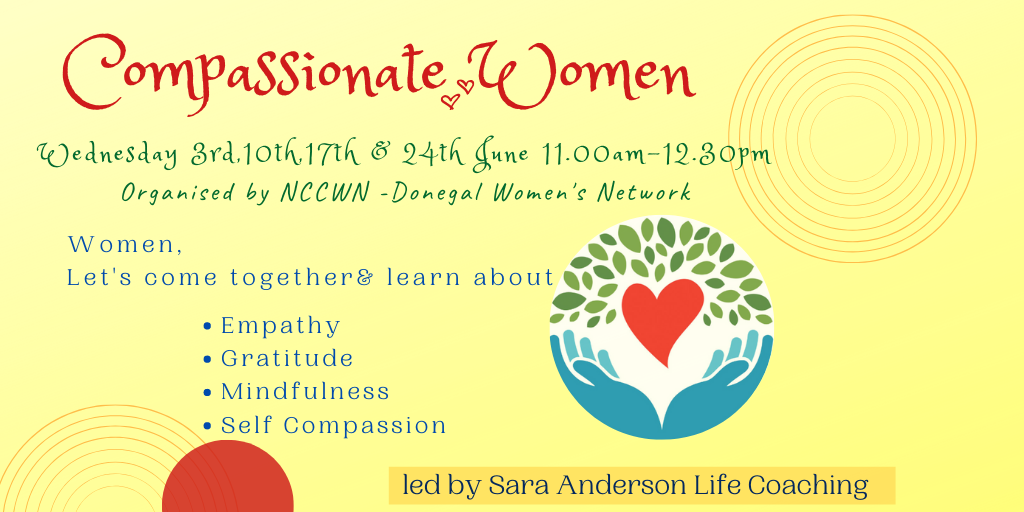
NCCWN Donegal Women’s Network are pleased to be taking bookings for the New Compassionate Women course by Life Coach Sara Anderson. This is a FREE 4-week online group course which is being offered on a voluntary basic by Sara and will start on Wednesday 3rd June 11am-12.30pm. The aim of this course is to support women in their health and wellness, promoting personal development, well-being and positive mental health. Over the four weeks’ participants will be introduced to and learn about self-compassion, its importance for wellness and how you can develop it.


Through guided practice participants will learn mindfulness, empathy, and gratitude techniques allowing you to develop the tools and methods that will leave you feeling better about yourself and the world around you.


Venue: Online via Zoom

Dates: Wednesday 3rd, 10th, 17th and 24th June

Time: 11.00am-12.30pm


If you are interested in participating in this programme please fill in our online form here and someone will be in contact with you. For further information please contact NCCWN Donegal Women’s Network by email on donegalwomensnetwork@gmail.com. Booking is essential, book early to avoid disappointment.


The Compassionate Women group course is designed and facilitated by Sara Anderson, who has a working history and experience of working with groups and vast training experience in life coaching, drama therapy, mediation, mindfulness and many other modalities. She can be found on facebook @saratappingcoach or by mobile on 087 7189 620

The Ripple Effect: Making Change in a Changing World

In this ‘Women’s Live’s, Women’s Voice’ feature Gortahork local Joanne Butler shares her journey of becoming an environment educator and setting up the social enterprise OURganic Gardens an outdoor green space focused on food, sustainability, and horticulture. While also reflecting on her learning experience and the importance of embracing sustainable living and making small changes to support the environment.


16 Years ago I moved to Donegal, coming for the big smoke of Derry to a relatively rural area and never having grown a vegetable in my life. The following year in 2004 having tasted my first cabbage straight from the field, I asked my landlord at the time for a drill and bought my first seeds. In 2008 my husband and I bought an old cottage with a wonderful view in Gort a’ Choirce. We carefully restored the house for myself, my husband and my (then only) daughter to live in.

Three years later now with 3 children we started to slowly work on our 4 acre garden at this stage I was already growing some of our own food  for a number years but,  I still  was not really aware of where our food comes, thinking back on it now, I was living in a bubble, a nice cosy ‘good life’ bubble as we had observed the land for a number of years (being a bit busy with the kids) we now felt confident to start working on the plans we made.


First things first we wanted to clear the land as much as possible and as natural as possible, so we enlisted the help of a few friends, we enlisted the help of some pigs and they got straight to work clearing the ground for us. In 2013 my local community group Pobail Le Chéile asked me to run a Community Garden, it pushed my boundaries and enabled me to work with people in my local community, we shared tips, stories and food.


Coming initially from a background always doing some sort of community work I wanted to put together a programme of events that reconnected the links between the food we grow, the food we eat and the people we feed.  We ended the year with a harvest festival, inviting people from all over the area to come together to celebrate food and enjoy the experience of coming together in a social setting. This sparked the flame and OURganic Gardens was born.


That winter I attended many courses and events around the country connected with community gardening, I joined the community garden network and completed my FETAC level 6 train the trainer. I put together a community garden course working with local people growing, cooking and connecting with each other.


I then started to look beyond just the gardening aspect of it , outside the ‘bubble’, I wanted to bring more than just healthy eating into the classes, I wanted  to show people the impacts of what we do here now, locally and how it will affect other people in the future and Globally.

In February 2014, I began a FETAC level 4 in Global Development with Donegal ChangeMakers, this opened doors I didn’t even know existed. It took me on a journey of learning that not only burst that bubble but entered me into a whole new world of conscious thinking. Hearing the shocking, hard hitting facts I learnt left me feeling overwhelmed to say the least. We looked at the developing countries and how our lives here, affect their lives there. And then more than ever this word CHANGE started to resonate deep within.


I went on to complete a tutor facilitator course and I remember hearing  more and more disturbing  insights into the global state of play, where we were at with our natural environment. I had heard enough, I left the course early on the last day barely unable to breath …. I had heard a lot …. I thought to myself … What could I possibly do in any way that could make one ounce of impact in the world today. In tears I wept, for the peoples who’s lives that our choices are destroying, the unfair food trades that are dealt. For the lack of control that we have over large companies that wreak havoc on our food and the environment.


But it was then that for me the defining moment came. And it was around that time that the ripple effect, for me came into play. I realised that what we do here, now and the choices we make, while at the time may feel like it’s only a tiny drop in a puddle. But if we allow this drop to affect everything it meets, then in turn this drop creates the possibility to reach all of the ocean. Even the smallest changes we make can affect the people around us.


“For me community gardening and teaching about growing local food became my drop”


Since then I have worked with lots of different groups in community gardens and Community Gardens Ireland. Fast Forward four years and the more that I left home to work with people about sustainable living, I realised that I was not being sustainable myself, I was driving all over the county and beyond and not taking time out for me, my family and my garden. So since the beginning of 2018 I took the decision to start to work from my home garden in Gortahork. To start a social enterprise that will show people how and why I do it.

68241716_10156193629266560_1902912902902317056_o

I have since discovered permaculture which is set of ethics and principles that help me understand nature and work with it rather than against it.


EARTH CARE – PEOPLE CARE – AND FAIR SHARE

permaculture


When I work with groups now we talk about the nature of our global food system. A system where the fruit, vegetables, and herbs found in grocery stores have often been grown hundreds of miles from our kitchens and packed, shipped, distributed, and displayed, all while being refrigerated, this is a process that can wreak havoc not only on the environment but on the flavour and nutrients.

To talk about how growing a simple bag of salad naturally at home can not only cut down on your chemical intake, but in terms of the water it takes to grow the vegetable from seed to bag. In a country like Kenya where water charges are literally costing the earth. As most companies’ triple wash their salads at packaging point, we are literally running the well dry and that doesn’t even take in the transport.

joanne 2

To learn about how only a few generations ago, most of the food on the dinner table had been growing in gardens only hours before it was served. While it would be a full-time job these days to feed your family this way, it’s surprisingly easy and fun to grow some of the staples on your grocery list and it saves a whole lot of air miles in between.


We follow the principles as best we can. We observe nature, use and value diversity, produce no waste and use small and slow solutions. Now me and my family have taken it one step further and have looked at these permaculture principles in all our aspects of life at home. From saving our rainwater, building with natural materials, managing our waste materials and using renewable resources we are hoping to show people how they can live more sustainable lives on a home scale basis.

69911756_2406689436035154_6369487674503331840_oI now work with a fantastic team at OURganic Gardens and during 2019 we ran successful  courses in Permaculture, Horticulture and social and therapeutic gardening. We have set up volunteer days and community garden co-operative sessions. We have done numerous walks and talks around the land and we have even set up a small stall at the house providing surplus vegetables to the community with an honesty box to help keep the garden going.

This year we plan to do more of the same with some extra workshops and further development on the land. Who knows what route our learning together will take at OURganic Gardens, but one thing I do know and  that’s the more and more people we can get involved in our garden project then the more and more people that we can get thinking about their own ripple effects and in the near future we look forward to a tidal wave of hope from all of the ocean!

Go Raibh Maith Agat


Adapting to Change

Joanne is currently doing a series of online live facebook videos on Sundays under the title #GrowTogetherDonegal check it out here 


NCCWN Donegal Women’s Network are always looking for women to share their stories and looking for women to write features on topics of their choice which we will profile as part of our Women’s Lives, Women’s Voices’ series.