Archives

Let’s Celebrate Women Farmers in Donegal


This feature is a Women’s Collective Ireland- Donegal, ‘Women’s Lives, Women’s Voices’ feature. Written in celebration of Rural Women’s Day to raise awareness to the role Donegal Women play in agriculture and rural development. With an inspiring afternoon at The Milk Bar with its founder Shannon Porter


Did you know Sunday 15th October 2023 marks International Day of Rural Women? The day was first observed in 2008 to recognises the role of rural women, including indigenous women, in enhancing agricultural and rural development, improving food security and eradicating rural poverty.

It was suggested that October 15 be celebrated as “World Rural Women’s Day,” which is the eve of World Food Day, to highlight rural women’s role in food production and food security. “World Rural Women’s Day” was previously celebrated across the world for more than a decade before it was officially a UN observance. The theme for this day is “Rural Women Cultivating Good Food for All”, which highlights the essential role rural women play in the food system.

At Women’s Collective Ireland-Donegal we felt it was important that we take the opportunity to celebrate the contribution and successes of the women working in agriculture and rural development locally here in Donegal. During the summer WCI-Donegal development worker Rhona Hannigan took a trip to the Milk Bar to interview Donegal local farmer and the Milk Bar founder Shannon Porter to see the great work she is doing in Dairy farming and the business she has created.


The Milk Bar opened its doors on the 24th of September 2021, an innovative concept of local girl Shannon Porter. Shannon grew up on the family dairy farm in Lusticle, Carrigans in the North West of Donegal. Chatting with Shannon it is evident that she is passionate about dairy farming, she has managed to turn her passion into a thriving business that is going from strength to strength. The Milk Bar is situated on the family farm and uses the freshest milk that is pasteurised on site, but it is not homogenised, leaving the creamy layer on top.


Shannon’s passion for the agriculture sector developed from growing up on a large farm, both her parents come from a farming background and passed on their skills for sustainable farming with an innovative approach. The family business dates back to the 50’s and 60’s when Shannon’s great grandfather Jack and great grandmother Henrietta Porter started to provide milk to the village, known as Millburn Dairies. In those days you collected the milk at the dwelling house in a tin can. Later the milk was delivered in glass bottles to your doorstep. Over time the glass bottles were replaced by milk cartoons and plastic containers. ‘The Milk Bar’ has reverted back to glass bottles with sustainability at the forefront, reducing the use of plastic. Shannon got the idea when she studied Agricultural Science at university, graduating with a BSc Honors Degree in Agriculture from Harper Adams University. She set up the business during covid which was risky, but it proved successful because of the self service vending machines. The milk itself is beautiful, fresh and a novel idea that promotes local produce.


Shannon choose a general agriculture course that covered all areas of agriculture from livestock, crops, business, environment and sustainable farming. While studying Shannon worked on dairy farms of varying sizes to support her studies and to expand her knowledge of the sector. Getting experience from the farm at home, to working in the UK and New Zealand, developing practical farming skills in all areas of agriculture. Shannon’s talents were recognised at University when she was a finalist for the Royal Association of British Dairy Farmers Dairy Student Award 2021. She was runner up in 2022 in the Food Coast Donegal Awards and a finalist in Blas na hEireann Irish Food Awards in 2023 for her milk and ice-cream. A growing number of local businesses are selling and using the milk now. Its freshness and creaminess makes a hugh difference when making frothy coffees Shannon mentioned.


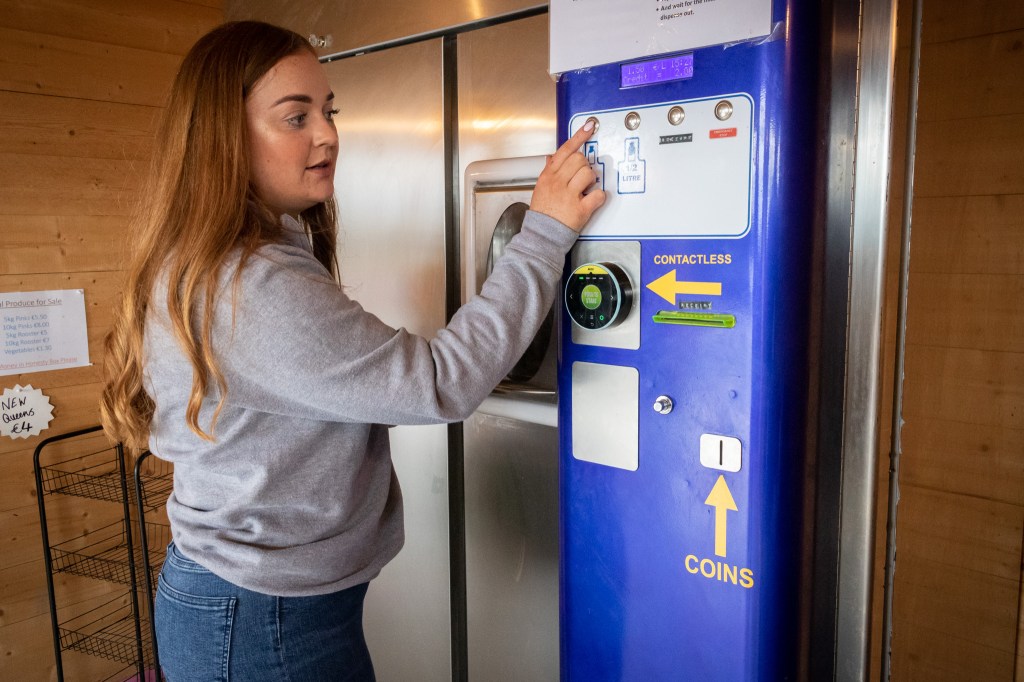
The farm produces around 6ooo litres per year, most of which is sold to creameries, the milk is collected every two days, processed and then sold to consumers. It is worth noting that the milk in the Milk Bar is straight from the farm, pasteurised on the farm, as fresh as you can get. As a businesswomen profit is important but animal welfare also features highly. With Shannon at the helm I have no doubt the business will continue to thrive and diversify.

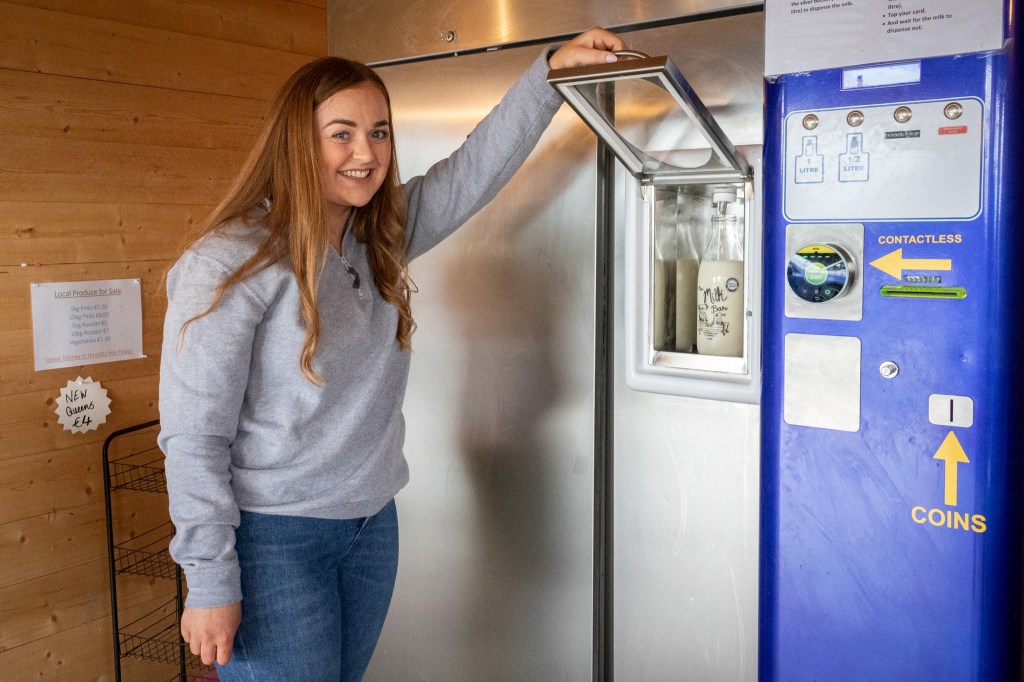
Farming is not a traditional route for women, increasingly gender balance is being achieved in most sectors, however, in Ireland only 13% of farms are owned by women. A situation contributed to the fact that men in Ireland significantly outnumbered women as the holders of family farms. In 2016, male ownership stood at 88.3% compared with 11.7% female ownership. This can be attributed to a myriad of social, cultural, legal and financial reasons for the low rate of female farm ownership.

But change is happening and the innovation and vision of young women like Shannon, provides an example to other women who may want to create a future in farming. Women in farming has been an area we have highlighted before, in 2021 as part of our Donegal femLENS exhibition, we feature two thought provoking documentary photography projects which focused on women in farming, you can view these projects here “Focus on Female Farmers” and “The Farm Hers”.


Women’s collective Ireland-Donegal would like to thank Shannon for inviting Women’s Collective Donegal up to the farm and taking the time to show Rhona around and take part in the women’s lives, women’s voices series. Shannon is a role model for young women in Donegal and beyond. We would also like to thank femLENS participant Maud McClean, who volunteered her time and budding photography skills to take pictures for this rural women’s day feature.

We are always looking for women to share their stories and looking for women to write features on topics of their choice which we will profile as part of our Women’s Lives, Women’s Voices’ series. If you would like to get involved please drop us an email at donegal@womenscollective.ie


Nothing is Beyond Your Reach

This feature is part of the Women’s Collective Ireland- Donegal, “Women’s Lives, Women’s Voices’ series. Written by Siobhan Cullen LLb Msc Solicitor Mediator. This story recounts Siobhan’s life from childhood, her passion for justice and equality and the journey that led to her being appointed as one of the Equality Commissioners for Northern Ireland.


I have always had a strong interest in equality and anti-discrimination policies, possibly due to my upbringing by Irish emigrant parents in North London. My dad was from Dublin and mum is from Donegal and they moved to London in 1960 where they lived for 40 years before returning to Donegal. We lived in a very diverse and multi-ethnic community on a council estate which was a brilliant experience in terms of developing social skills, resilience and acted as a grounding for my interest in equality.

I recall incidents during the 1970’s and 1980’s involving discriminatory behaviour by the authorities. One thing I recall is the regular police questioning of my next-door neighbours, who were from the West Indies, about their whereabouts when a crime had been committed locally. There was also some anti-Irish sentiment during the 1980’s and I vividly remember anti-Irish graffiti being sprayed locally during the troubles.

I felt very much part of the Irish community in London and social justice was often on my mind so, at the age of 14, I decided that I wanted to become a criminal defence solicitor. As the first person in my family to go to college, I attended Middlesex University in Hendon aged 18. I initially felt slightly challenged and lacking in confidence as a student. I’ve always empathised with students who feel this way as I remember it well, especially on the first day when I was tempted to leave the lecture hall amid many vocal and confident peers. It was the empathy and inclusive attitude of certain lecturers that engaged me, something I later aspired to become in my own teaching career.


I obtained a first-class law degree and qualified as a solicitor three years later, aged 24, specialising in criminal defence and family law. I worked for eight years in a legal aid firm in Tottenham, North London during which time I probably learnt more than during any other time in my life.

This experience shaped me and made me who I am today, without a doubt. It was fulfilling work but also challenging as many clients had suffered trauma and abuse as well as having addiction and mental health issues. I spent much of my time in police stations and court and represented clients in every type of case imaginable, some very traumatic.

I really enjoyed the family law work, representing many women in domestic violence applications and child-care proceedings. I found representing clients in court, especially juvenile cases, so incredibly interesting and fulfilling. It was also challenging as legal aid work was hugely under-funded, something which has unfortunately disimproved even more in recent years. In my view, legal aid is a crucial aspect of access to justice which was my entire purpose back then and this remains so today. I also volunteered for FLAC during this time and set up a legal advice clinic in the local psychiatric hospital.


In 1999 I moved to Ireland, always my “spiritual home”, and undertook a Masters in Equality Studies at UCD and then begun an academic career with Letterkenny Institute of Technology (LYIT) where I remained for twenty-two years. I loved working with students and delivered modules in Family & Child Law, Legal Systems, Restorative Justice, Tort, Law in Action, Mediation and Street Law, the latter of which is my all-time favourite aspect of legal education.

Street Law is a form of public legal education whereby law students are trained to deliver law programmes in schools and community settings, developing their skills through experiential learning but also really enhancing the legal knowledge of the participants. It helps to remove the mystique and elitism often associated with law and build legal literacy skills within communities which really enables people to embrace the law, use it to their advantage and not view it as something to be feared.

I developed the Street Law programme at LYIT with a brilliant colleague who has a similar interest in experiential learning, and we worked with many fantastic students, many of whom I am still in contact with as they embark upon and continue their professional careers. This is one advantage of social media as it makes networking and keeping in touch with alumni so much easier, which is mutually beneficial. I was Head of Department of Law, Public Service and Education for 5 years and then took a career break last year to embrace some new and exciting challenges.


I joined the Open University as a law lecturer, and I cannot speak highly enough of the OU’s policies and practices in relation to accessibility, inclusivity, and student-centred ethos. It really does walk the walk. The flexibility of online distance learning is so appealing, the student body is diverse with many students having full-time jobs and family commitments, caring responsibilities and some residing in secure accommodation. Colleagues are incredibly supportive of each other as well as students and the social justice ethos prevails at every level. The fairness and equality which underpins every aspect of the OU, from student-facing policies to staff policies, is authentic and an exemplar of what EDI means in practice. An example would be that every assessment is reviewed by several critical readers to ensure compliance with policies and accessibility to all students with alternative versions provided for students with additional needs or accessibility issues.


My recent appointment as an Equality Commissioner for Northern Ireland (ECNI) has really been extremely fulfilling. I am privileged to work with such a brilliant organisation, supporting and maintaining equality by monitoring compliance with statutory duties, providing legal assistance in legal actions and raising awareness. The work undertaken by the commission is crucial and some of the recently successful cases are testament to this. This is a particularly challenging time in Northern Ireland with post-Brexit issues and I am honoured to work with fantastic colleagues, both commissioners and the legal officers/ full-time staff to support the community through these challenging times.

I am also a Tribunal member with the Mental Health Commission as I have always had a strong interest in mental health, and I strongly believe that the Tribunals play a vital role in upholding human rights and rights of persons detained.

I have recently been appointed as a Tribunal member with IPAT (International Protection Appeals Tribunal) which hears appeals from applicants seeking refugee status and/or subsidiary protection.

I’m on the Board of Donegal Sports Partnership, an amazing organisation based entirely on the ethos of inclusivity, accessibility with a real focus on sport for those of us with additional needs as well as gender and ethnicity.

I am currently Chair of Donegal Women’s Centre which provides invaluable services to local women, including medical, counselling and programme facilitation. Again, there is a great team delivering these vital services with such commitment and drive which is a common theme in the community/ voluntary sector.

I am also a voluntary panel assessor with Athena Swan Ireland which considers applications from HEI’s for gender equality recognition, a very significant development within the education sector. Gender equality is an issue that is very high on my personal agenda from every perspective, and I am delighted to have been appointed Athena Swan lead at the OU Law School for 2023/24.


I hope my story, including humble beginnings, initial lack of confidence as a law student and the development of my career trajectory will inspire other women to follow their dreams.

If in doubt, I would say to volunteer as this is such a good pathway to experience and demonstrates commitment.  I have always done some voluntary work and hopefully this will continue. The common theme in all my current roles is teamwork and commitment which are key to supporting communities and developing change.

There are so many aspects to law, some more lucrative than others, yet I find that the areas I have chosen to work in are the most fulfilling for me personally.

I started working in criminal defence, my dream aged 14, and I am now in a place I have always wanted to be, enhancing equality and human rights with only one goal in mind, improving access to both justice and education for everyone.


WCI-Donegal are always looking for women to share their stories and looking for women to write features on topics of their choice which we will profile as part of our Women’s Lives, Women’s Voices’ series.